the hold room ad

Routesetting Trends 2025

2025 Routesetting Trends
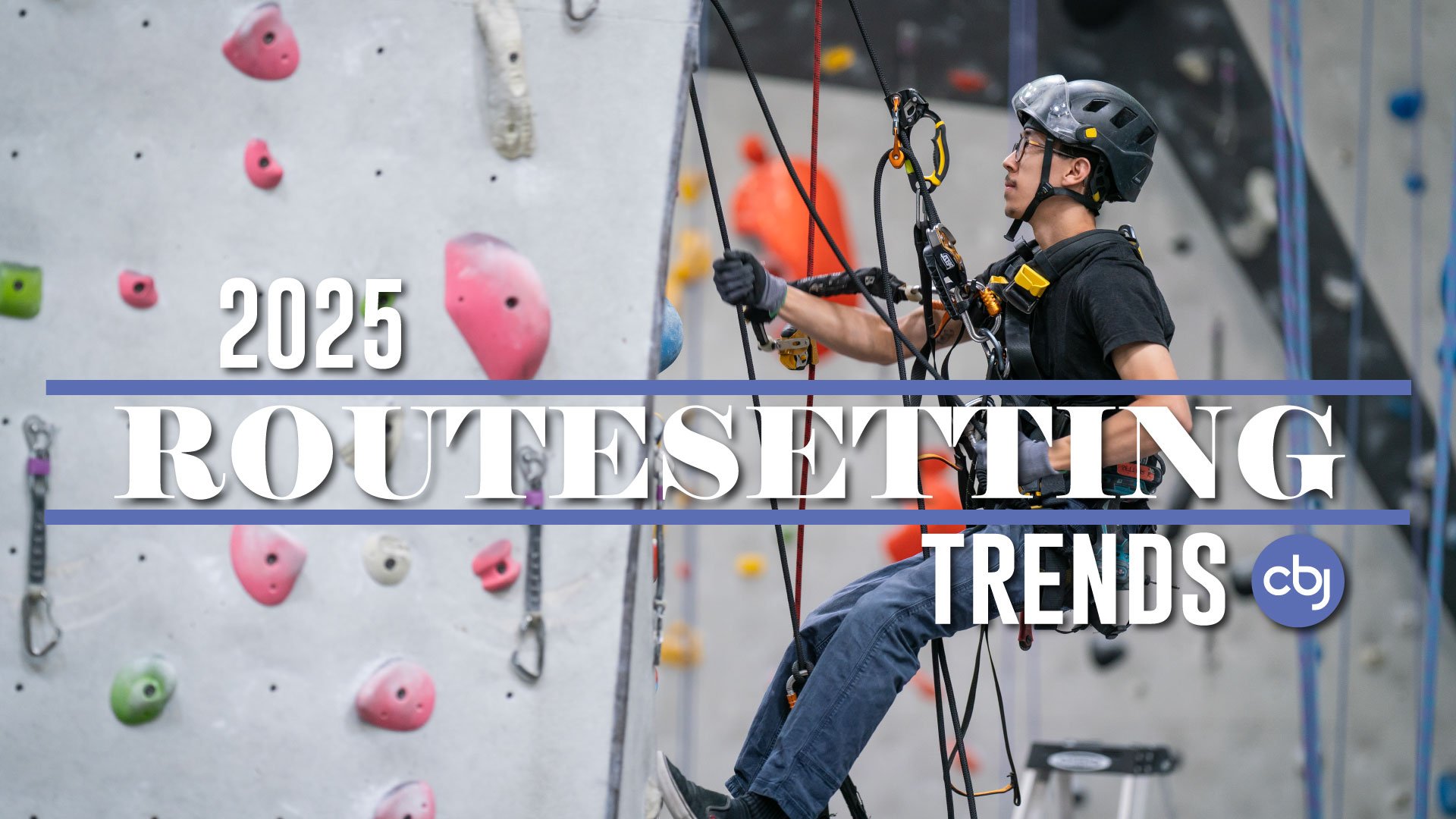
Safety standards, certifications, route density and turnover, movement styles, equipment innovations…this year’s Routesetting Trends Survey provided a glimpse into all the latest happenings around the routesetting profession. (Photo by Jason Chang @theshortbeta at Sender One’s SNA gym)

Words like “data” and “analytics” can sometimes feel out of place in such an artistic, physical craft like routesetting. Yet as the profession becomes more modernized—trading the wild west days for elevated standards, increased safety measures and an improved customer experience—the use of statistics is becoming ingrained in our day-to-day work and another essential tool to metaphorically add on the toolbelt.

Some routesetting trends from 2025, it should be said, require little quantification. Our 2024 Routesetting Trends report identified rising professionalism within the field as the number one trend last year, and that progress took a big step forward this year with the launch of the Climbing Wall Association’s Professional Routesetting Certification Program (PRS)—the first of its kind in North America geared specifically toward commercial setting.

onsite ad

Other new developments of late, like the introduction of climb tracking cameras fueled by artificial intelligence, fall squarely on the road where statistics and setting merge. For years, setters have been logging route turnover, grade distributions and other basic figures, first on paper, then on spreadsheets, and today in dedicated routesetting management platforms. Just how ubiquitous more advanced technology will become is yet to be seen, but the technology is out there and is certainly being talked about in 2025.

What other happenings have routesetters around the industry been noticing? Below are five takeaways we had after surveying over 300 setters—predominately from North America (57%) or Europe (35%)—and crunching the numbers. Professional development and safety patterns, popular movement styles, route density and turnover spreads, the new equipment and holds that setters have been talking about most…we discuss it all in this year’s Routesetting Trends report, and the charts with the full results can be found at the end of the article.

Thank you to all the routesetters who helped expand our collective knowledge and drive the industry forward by taking the survey!

Access the Report

Want to access the report?

  • Took the survey? We sent you an email with information on accessing the report for FREE (please reach out here if not) and a promo code for $20 off any new membership.

Missed this year’s survey? Keep an eye out for next year’s, so you can get free access to the report and help us make the sample size even more meaningful!

  • CBJ member at any paid level? Just log in to view the report!
  • Not yet a CBJ member? Don’t miss out! Check with your employer to see if they already have a seat for you, and if not you can learn more and enroll here. Every paid level is packed with valuable benefits starting at $150/year.
A PRS Level 2 course at this year’s Setter Summit, held at The Front SLC
At least in North America, the launch of the CWA’s PRS program was perhaps the most notable evolution in professional development in 2025, and more PRS certifications are on the way. (Photo by Foxman McCarthy-James of a PRS Level 2 course at this year’s Setter Summit, held at The Front SLC)

1. Certifications are still not the norm and hurdles exist, but the tides are changing

One of the big topics covered in more detail in this year’s Routesetting Trends Survey was professional development, including the prevalence of various certifications in the profession. Somewhat surprisingly, despite access to USA Climbing’s routesetting certifications being a hot button topic in recent years, nearly half of the respondents from North America who took the survey (44%) held a USAC Level 1 certification or higher. Although USAC’s levels are focused primarily on competition setting and were never meant to fill the need for a commercial pathway, the fact they were still so common among surveyed setters is a reminder that USAC’s levels were still the main certification avenue for years, before the CWA’s PRS levels came along.

It’s also interesting to note that those new PRS certifications—which have been available for less than a year and are still getting going—were already held by 5% of survey respondents from North America, suggesting they’ve been a welcome addition to the industry.

In general, while it’s still more common to not have these kinds of certifications—none of the certifications listed in the survey were held by more than 50% of the respondents—in many ways the overall trajectory of professional development within the field has been positive. When asked whether they have undertaken more, about the same, or less professional development in the past year, 29% of survey respondents said they had done more, while just 17% said they had done less. Professional development may be on the rise outside North America especially, where surveyed setters were about twice as likely to say they’d undertaken more of it in the past year.

However, that uptick isn’t always distributed evenly. For the majority of the professional development opportunities listed in the survey—attending a clinic or tradeshow, guest setting, watching a webinar, etc.—the respondents who are men were more likely than those who are women, non-binary/non-conforming or preferred not to say their gender to have undertaken them in the past year. And white respondents were typically more likely to have undertaken the listed professional development opportunities than respondents of other races and ethnicities or those who preferred not to say their race/ethnicity.

There may be more certification clinics around these days, but hurdles to attending them still exist. They don’t occur in every region, for example, and several routesetters noted it can be costly to take time off work or travel a long distance to get to a clinic, when their home gym can’t find the budget to help out or host one. “The available certificates this past year were all out of state, which is very expensive for traveling, especially to only get an L1 cert,” lamented one setter. “I have also reached out to gyms in the area to guest set and have received no responses.”

Hopefully, with more PRS clinics and other opportunities popping up—whether in-house programs, off-site workshops or virtual lessons—those tides will keep changing. And the PRS Provider certification (PRS Pro), which is currently pending finalization, should soon make it easier for more setters to get certified directly through their home gym, instead of having to travel to an out-of-state clinic or assessment.

A routesetting barrier in use at the PRS Level 2 course
Although further steps may be needed to see PPE and safety systems required in more gyms, there’s no doubt that more setters in recent years are using eye protection, barriers, and other safety measures.

2. Safety standards are continuing to improve, even if the numbers haven’t caught up yet and more progress is needed

Alongside the growth in professional development has been the increase in safety measures observed over the years. In 2025, nearly all setters responding to CBJ’s Routesetting Trends Survey (94%) said they felt either somewhat or a lot that safety standards are improving fast or well enough in the industry, compared to just 6% who said they felt that this was not at all the case. That positivity was even more pronounced among respondents whose primary facility where they set is a full-service facility; 39% of those setters said they felt a lot that standards are improving, compared to 23% of the setters at bouldering-focused facilities.

Practically across the board, though, the figures for required personal protective equipment (PPE)—the percentages of surveyed setters who said the listed forms of PPE were required at their primary facility—were largely about the same as last year (58% for eye pro, 23% for ear pro, 22% for both eye and ear pro in 2025). And the figures for safety systems required at full-service facilities didn’t change much either (51% for helmets, 28% for full-body harnesses, 34% for mechanical lifts in 2025). In fact, some figures for required safety systems even slightly declined from 2024 to 2025 (42% to 34% for two-rope systems with a dedicated fall arrest line; 47% to 32% for recreational/sport harnesses not being allowed). Among the surveyed setters who were primarily working at full-service facilities, less than half said their facility had a written work-at-height plan, and about only one out of three said rescue training was required.

Norms around safety can also vary substantially from gym to gym and country to country. When comparing surveyed setters in North America to those on a different continent, required closed-toe shoes and ladder stabilization, for example, were less common among the latter group, and international respondents were also less likely to say they felt a lot that safety standards are improving fast or well enough in the industry. As one setter speaking about the United Kingdom said, “Safety standards are improving but slowly because routesetting is still a fairly niche job, particularly rope setting, where there is the most potential for developing safety standards.”

However, since climbing facilities are unlikely to be scaling back safety systems and PPE requirements once they’re implemented, most likely the few declines from 2024 to 2025 were due to a different sample of setters responding to this year’s survey and a more representative average is somewhere in the middle. Additionally, it’s important to note that even where some facilities are not explicitly requiring certain safety measures, many routesetters have been choosing to adopt best practices anyway. When just looking at the percentages of setters using the listed forms of PPE—whether required or optional—those figures are much higher than the figures for required PPE (84% for eye pro, 60% for ear pro, 36% for eye and ear pro, 56% for gloves, 87% for safety barriers, 90% for closed-toe shoes, 73% for ladder stabilization).

In reading the survey comments on whether safety standards are improving fast or well enough, two observations were clear: The culture around safety and following best practices in the routesetting profession has certainly improved from years past, but, at the same time, more progress is needed to raise the bar in more workplaces worldwide. Given the cited growth in professional development around the industry and outside North America, in particular, it may only be a matter of time before the numbers catch up and, ideally, far surpass previous marks.

Two routesetters forerunning at Project Konepaja in Finland
In addition to a facility’s size, the number of routes being set and how often they’re being swapped out can also heavily depend on a gym’s mission and the clientele they’re serving. (Photo by Sami Laitinen of the new, training-focused Project Konepaja gym in Helsinki, Finland)

3. Routes may be turning over faster in North America, but there’s likely less of them

Two more topics covered for the first time in this year’s Routesetting Trends Survey, at least from a birds-eye point of view, were route density and turnover. As expected, bouldering routes were generally turning over much faster than roped routes at the primary facilities where respondents were setting. Two out of three surveyed setters said bouldering routes stayed up for five weeks or less, whereas less than 5% of the setters said that was the case for lead and top rope routes.

Similar to the safety data, there was a noticeable difference between route turnover at the primary facilities where respondents in North America were setting and turnover on other continents. Based on the sample, both roped and bouldering routes generally turned over faster in North America—especially roped routes. Among respondents primarily setting at a full-service facility, roughly 40% outside North America said lead and top rope routes stayed up for 12 weeks or more, compared to less than 20% in North America.

However, in general there was a lower density of top rope routes at the full-service facilities where international respondents were primarily setting; 13% of the international respondents said those facilities have 75 top rope routes or more, compared to 39% of respondents in North America. Instead, full-service facilities abroad seem to be putting more of an emphasis on bouldering routes, based on the survey results; 47% of respondents outside North America said their full-service facility has 100 bouldering routes or more, compared to 34% of respondents in North America.

As one would expect, facility size—the amount of square feet of climbing at a facility—highly impacted the number of routes set. So, be sure to check out the single-page Route Density & Turnover dashboard at the end of this report, play around with the filters, and see how the distributions compare based on your facility’s characteristics.

A climber ascends a boulder at Sender One's LAX gym
Modern gyms often have a fair share of routes inspired by moves seen on the competition stage or in Instagram reels, but in many places there’s still an appreciation for well-set, “old-school” climbs as well. (Photo by Jason Chang @theshortbeta at Sender One’s LAX location)

4. When it comes to movements and styles, it’s been out with the old and in with the…new and old?

As for the types of movement that surveyed setters have been putting up, there’s no doubt that dynamic, competition-style setting was still in vogue in 2025. Even more so than last year, references to “compy” moves topped the list of comments setters had this year on how setting styles have been changing. With the next Olympics in Los Angeles—home soil for the majority of respondents—drawing closer and paraclimbing set for its Paralympics debut in 2028, it’s safe to expect that trend to continue in the years ahead. In the meantime, events like the recent IFSC Nations Grand Finale—which, according to the IFSC’s website, “[drew] inspiration from the Boulder Mixed Team event successfully tested in Salt Lake City, USA, in 2021”—have been providing plenty of entertainment. And in North America this year, USA Climbing released its new four-year strategic plan, laying out its pillars and vision for competition climbing in the U.S leading up to LA 2028.

But perhaps most interesting from this year’s Routesetting Trends Survey results, in regard to the movements seen on climbing walls, was not just the popularity of modern, “new-school” elements but the number of setters prioritizing traditional, “old-school” styles as well. In fact, both schools of thought were nearly equally mentioned in the comments this year, and many setters noted their crews were making an intentional effort to incorporate both where they set.

The reason for that trend cited most often by respondents goes to the heart of what commercial routesetting is all about: Ultimately, setters are building products for customers, and since there’s typically a variety of interests within a gym community, catering to one’s specific clientele has often looked like having a diverse, equitable spread of route styles and difficulties.

“I think that ‘comp’ style and traditional movement patterns are starting to blend and become welcome in a space,” wrote one setter. “As climbing grows and our audiences follow, we need to provide a diverse product and really stay in tune with what our communities are asking for. All or nothing mentality should be avoided at all costs when it comes to what we set. There’s always a percentage of people who want a certain thing, and it’s our job to sort of figure that out and have these differences be represented on the wall.”

Vital to that approach at most commercial gyms is also making a concerted effort to not just focus on retaining existing customers but helping expand the community by setting accessible climbs for beginners. Making climbs accessible for people with different bodies, abilities and interests is needed at every grade level, of course, but particularly for new climbers who are just discovering the sport. “As a facility that caters to a significant portion of our first-time climbers,” said another setter, “we prioritize providing an engaging and accessible climbing experience that immediately captivates them. We place a strong emphasis on equipping climbers with the ability to climb on holds and execute moves they’ve observed on social media or broadcasts at a level that suits their skill level. Since we often serve as climbers’ first introduction to the sport, we have the privilege of shaping their understanding of movements, holds and trends.”

Those two responsibilities of welcoming new climbers and setting accessible climbs have always been there, but the level to which they’re permeating the setting zeitgeist certainly seems to be growing as the profession modernizes.

Binary's new Clear Parabolas
Routesetters again showed an appreciation for recyclable holds in this year’s survey, and other trends like transparent grips were mentioned in the comments again too. (Photo of Binary’s new Clear Parabolas)

5. Recyclable grips are all the rage…and are hopefully here to stay

Finally, this year’s Routesetting Trends Survey was again paired with the Grip List Survey, so we couldn’t help but ask about the changes in climbing grips and other equipment that have been catching setters’ attention. By and large, the comments we heard the most this year pertained to recent developments in macros. Setters pointed out the increasing use of lighter, larger fiberglass shapes, as well the refinement of dual texture, noting a rise in no-tex grips and macros with a gradient of texture.

The number one evolution in macros that respondents mentioned most often was vacuum thermoforming technology (VTF). Discussed in past articles on CBJ and last year’s Routesetting Trends report, VTF-produced grips are usually made with acrylonitrile butadiene styrene (ABS) thermoplastic that’s often derived from recycled materials and—some might say the best part—can often be recycled at the end of its lifecycle. Setters praised how light and hard-wearing they’ve found ABS macros to be. “I like that things like VTF and fiberglass are becoming more normal—not schlepping around 50-pound macros makes my life a lot easier,” summed up one setter with a bit of hyperbole.

However, it’s important to note that most VTF-produced grips on the market today are not 100% recyclable. Typically the texture cannot be recycled, for instance, which is one of the reasons that some companies have experimented with alternative technologies like injection molding to produce fully recyclable holds. For the moment, though, it’s often been a tradeoff between high-quality texture versus recyclability, since many holds produced via injection molding have been said to be quite smooth and small. As technology advances, it’s not hard to imagine that roadblock being crossed with greater frequency, bringing more state-of-the-art shapes to setters’ closets that can be fully recycled.

Other shifts in holds that setters cited in the survey comments this year included an increase in the diversity of grips; stackable, modular holds and volumes; blocking and jibbing, now with metal washers in pre-made screw holds; rock-like grips, made more accurate of late with 3D printing; and aesthetic grips that catch the eye, like multi-colored grips and even some with a glitter-like appearance.

Other, non-holds-related innovations that respondents commented on in 2025 included full-body harnesses for different bodies, personalized impact drivers with a custom logo, and a smaller soft impact driver by Dewalt. As one Makita user had to admit about the new Dewalt drill: “It’s so cute.”

For all of the favorite holds, volumes, boards, apps and more that setters have been drooling over this year, be sure to check out the 2025 Grip List Awards in tandem with this report.

onsite ad

Limitations

Like any survey-based report, this one is not without its limitations, the most noteworthy being a sample size of 304 routesetters which, while robust, makes it hard to draw cross-industry conclusions. Especially when making comparisons across countries, it’s important to have sufficient representation from each country. A limited sample size may also have impacted the figures for required safety systems, since those numbers refer to only respondents primarily setting at a full-service facility. In the future, we’re aiming to have a higher turnout of setters taking the survey, for an even more meaningful analysis.

Another limitation is the use of categorical variables for the route density and route turnover data, which limited how granular the analysis could be. Especially when it comes to the former, the exact quantity of routes at a facility is deeply connected to the amount of climbing wall surface where those routes can be set, as well as what proportion of wall terrain is dedicated to which type of route (bouldering, top rope, lead, etc.). In the future, smaller ranges or precise quantities of routes and square footage data could be gathered and analyzed, for deeper insights.

Acknowledgements

This analysis truly would not be possible without the 304 routesetters who took the time to complete this year’s survey. Special thanks again to each and every one of you! It’s your hard work, day in and day out, that brings a climbing wall to life and helps keep our industry thriving. We’ve said it before, and we’ll say it again: you are rock stars!

Keep an eye out for next year’s Routesetting Trends Survey, so you can participate and get FREE access to the 2026 report!

Thanks as well to CBJ Publisher Scott Rennak, who led the survey promotion, data cleaning/prep and graphics creation; CBJ Editorial & Data Manager Joe Robinson, who analyzed the results and drafted the report; CBJ core team members Naomi Stevens, Megan Cheek and John Burgman, who reviewed the survey and report drafts; and all the CBJ members/advertisers who power our work.

Survey Results

Who took the survey?

  • This year’s Routesetting Trends Survey was taken by 304 routesetters spanning six continents, with slightly more representation from the United States than last year (48% in 2025 vs. 45% in 2024).
  • In total, the surveyed routesetters had an estimated 2,647 combined years of routesetting experience (8.7 years of experience per routesetter on average, up from 8.2 years in 2024).
Survey Respondents - Geography and Position
Similar to last year, there was nearly an even split between respondents who had a managerial routesetting position and those who did not, and there was a similar distribution of managerial vs. staff positions when comparing setters in North America to those on other continents.
Survey Respondents - Gender and Race/Ethnicity
The vast majority of surveyed setters were men, and 65% were both men and white/Caucasian.
Survey Respondents - Experience
As to be expected, there was largely a normal distribution of routesetting experience, and there was slightly more representation in 2025 of entry-level professionals in their first year (7% in 2025 vs. 5% in 2024) and experienced professionals with 11+ years of experience (29% in 2025 vs. 24% in 2024).
Survey Respondents - Facility Type
Of the respondents primarily setting at a commercial climbing gym, 53% said their gym was a full-service facility with roped walls and boulders, as opposed to a bouldering-focused gym.
Survey Respondents - Bouldering vs. Full Service
About the same number of respondents were mainly setting at a full-service facility vs. a bouldering-focused one, but representation of bouldering-focused facilities increased this year among surveyed setters in North America especially (32% in 2024 to 43% in 2025).
Survey Respondents - Single Location vs. Multiple Locations
It was more common for the primary facility where respondents were setting to be a single-location facility (55%) than a multi-location chain (45%), and that was especially true among respondents at a bouldering-focused facility (67% single location) compared to a full-service one (44% single location).
Survey Respondents - Wall Surface by Bouldering vs. Full Service
Among surveyed setters in North America, there was largely a normal distribution in the amount of climbing terrain at the primary facilities where respondents were setting, which as expected skewed larger for full-service facilities.
Survey Respondents - Wall Surface by Single Location vs. Multiple Locations
Facility size also skewed larger for multi-location chains (among respondents submitting square footage data, 41% set at a multi-location full-service facility with 20K+ sqft of climbing vs. 16% at a single location of that size; and 54% set at a multi-location bouldering-focused facility with 10K+ sqft of climbing vs. 20% at a single location of that size).
Survey Respondents - Number of facilities where setting
It was more likely for international respondents (14%) than those in North America (3%) to be setting at five or more facilities, suggesting freelance setting was maybe more common among the former group.

Professional Development

Professional Development - Certifications by Bouldering vs. Full Service
Practically across the board for each of the listed certifications, respondents in North America primarily setting at a full-service facility were more likely than those at a bouldering-focused facility to have completed them. Outside North America, 68% of the international setters surveyed had no certification at all.
Professional Development - Certifications by Gender and Race/Ethnicity
Respondents from North America who are white were less likely to have no certifications at all (41%) compared to surveyed setters of other races/ethnicities or those who preferred to not say their race/ethnicity (54%).
Professional Development Undertaken by Bouldering vs. Full Service
71% of the surveyed setters had undertaken at least one of the listed professional development opportunities in the past year.
Professional Development Undertaken by Gender and Race/Ethnicity
Surveyed setters who are women, non-binary/non-conforming or preferred not to say their gender were more likely to have attended a CWA routesetting clinic in the past year (7%) than respondents who are men (4%).
Professional Development Opportunities
Respondents primarily setting at a bouldering-focused facility were slightly less likely than those at a full-service one to say fewer professional development opportunities were available to them in the past year (15% for bouldering-focused vs. 19% for full-service).

Safety Trends

Safety - Eye Protection
It was more common for surveyed setters in North America (69%) than international setters (44%) to be required to use eye protection at their primary facility.
Safety - Ear Protection
Ear protection, on the other hand, was more commonly required at the primary facility where international respondents were setting (28% outside North America vs. 20% in North America).
Safety - Gloves
Of the PPE listed in the survey, gloves were the least common to be required (10% of surveyed setters in North America and 18% outside North America had to use them), and required gloves were particularly uncommon for respondents in North America setting mainly at a bouldering-focused facility (5%).
Safety - Barriers
Routesetting barriers were widely used and required, although they were less common to be required when a respondent’s primary facility was bouldering-focused (69%) rather than full-service (87%).
Safety - Closed-Toe Shoes
It was more common for respondents in North America (79%) to be required to use closed-toe shoes at their primary facility than international respondents (53%), but 90% of all the surveyed setters are using them whether they’re required or not.
Safety - Ladder Stabilization
Likewise, the required use of some form of ladder stabilization was more common at the primary facilities of respondents in North America (69%) than those of international setters (44%).
Safety Systems
Among respondents primarily setting at a full-service facility, it was more common for those in North America to be setting at a facility that has a work-at-height plan, required rescue training, required helmets or recreational/sport harnesses not allowed, while the use of a two-rope system with a dedicated fall arrest line, required full-body harnesses or a mechanical lift was more common outside North America. And for 14% of respondents at a full-service facility, none of the listed safety systems were in use.
Safety Standards Sentiment
Surveyed setters in North America (33%) were slightly more likely than the international respondents (28%) to say they felt a lot that safety standards are improving fast/well enough in the industry.

Movement Trends

Trends in Movements and Styles
Coordination moves were again frequently cited by respondents in 2025, even if they were a bit further down the list than in 2024. Other styles that carried over from last year’s comments included dynamic moves, comp movement, the use of bigger holds, an emphasis on aesthetics, and parkour-style climbs.

Equipment Trends

Trends in Holds and Equipment
Within the comments surveyed setters had on overarching changes in climbing grips and setting equipment, there were also a few mentions of specific brand releases in recent years, including Binary’s VTF-produced grips; Flathold’s transparent, no-tex Obsessed series; ArtLine’s adjustable Slopes; Escape’s dual-tex Storm macros; and So iLL’s new Finesse series, to name a few.

Route Density & Turnover


Use the scroll bar at the top right to see more of the dashboard. Hover your mouse over the dashboard and click on the icon in the lower right-hand corner to switch to full-screen mode.

Climbing Business Journal

Climbing Business Journal is an independent news outlet dedicated to covering the indoor climbing industry. Here you will find the latest coverage of climbing industry news, gym developments, industry best practices, risk management, climbing competitions, youth coaching and routesetting. Have an article idea? CBJ loves to hear from readers like you!