Today, most climbing gym operators open their doors in an area with an existing community of climbers. They can estimate the number of climbers in a catchment zone, hire staff who already know how to belay, and call a wall builder who has done dozens of projects like theirs within the country.
Weland Climbing had none of that. It is the first commercial climbing facility in Nigeria and in West Africa. When it opened last year, the addressable market for commercial climbing in the nation was effectively zero, because nobody had been to a local facility. There were no wall builders around, no climbing suppliers, no instructors to hire, and few customers familiar with the sport.
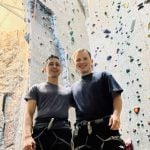
“Weland is quite different from a traditional professional climbing gym,” said Peter Zhang, who started the facility with Mengxuan Li—a husband and wife duo. “Most of our visitors come to experience climbing for the first time, rather than as regular climbers with an established training routine.”
That single fact drove almost every operational decision the couple made, from where they put the gym to which auto belays they bought.

Choosing Lagos and the site
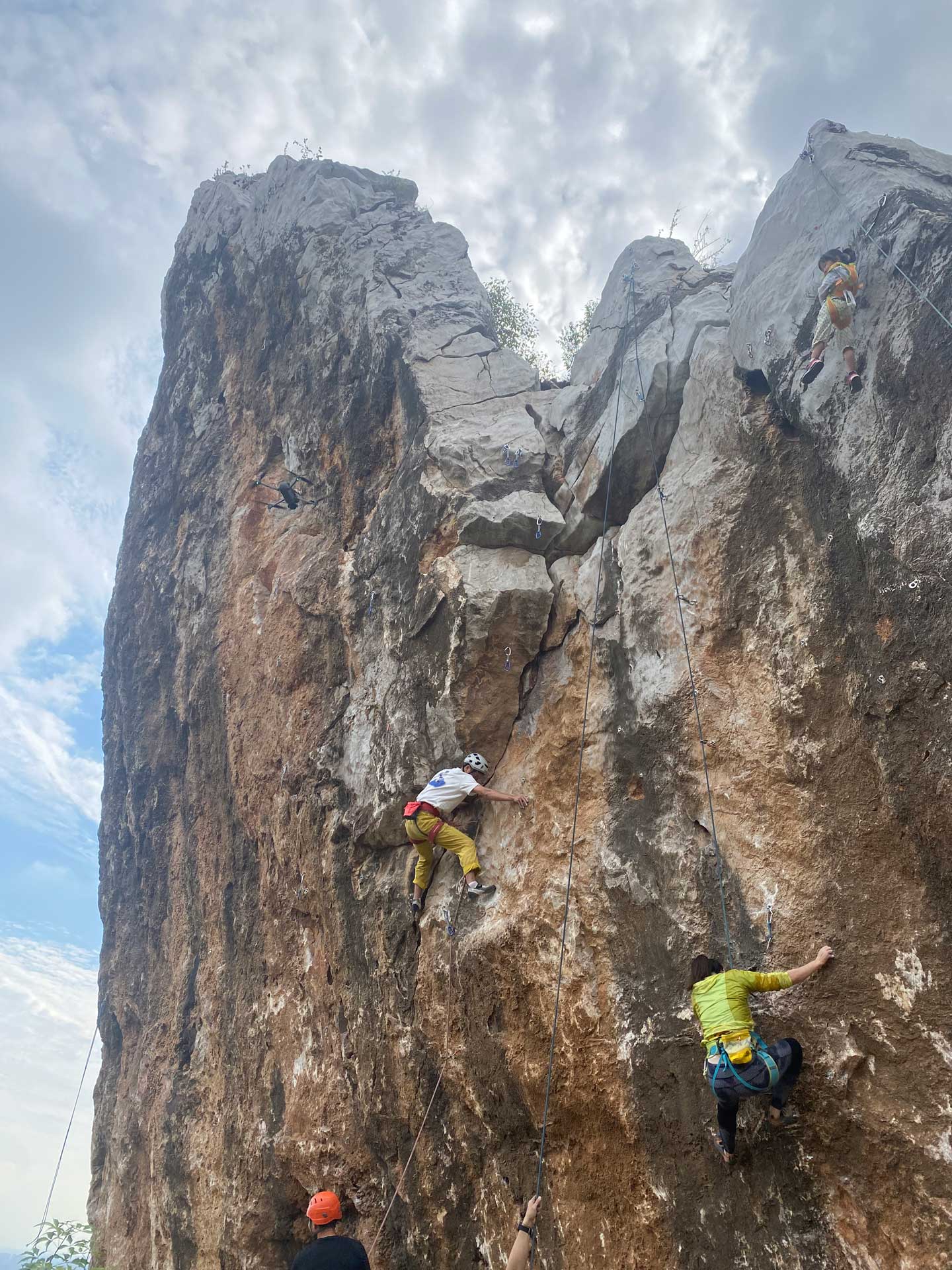
Zhang and Li founded Weland together. Zhang had run a climbing gym in China previously and had discovered and developed a natural climbing area at Qinglong Mountain in Nanjing, in his hometown, which became the design reference for the facility’s walls.
Lagos was chosen for reasons that will sound familiar to anyone who has evaluated a new city: “We saw a city with a large and diverse population, a growing interest in sports and lifestyle activities, but very limited access to climbing facilities,” Zhang said.
The site mattered as much as the city. The Landmark Centre is a beachfront leisure and entertainment complex on Victoria Island, and Zhang described the decision to locate the facility there as a two-way choice rather than a lease negotiation. Landmark Africa founder Paul Onwuanibe and his team backed the climbing project from the start.
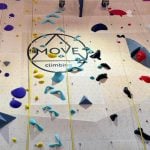
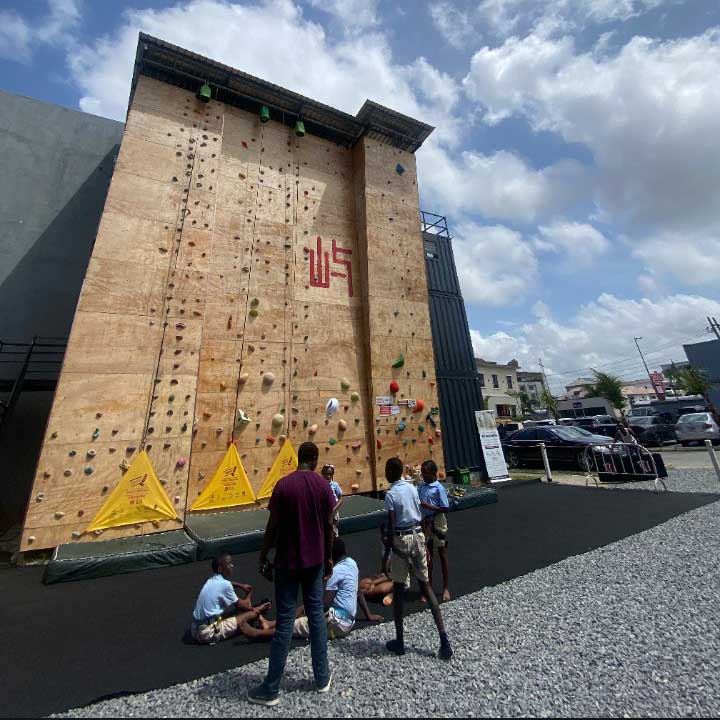
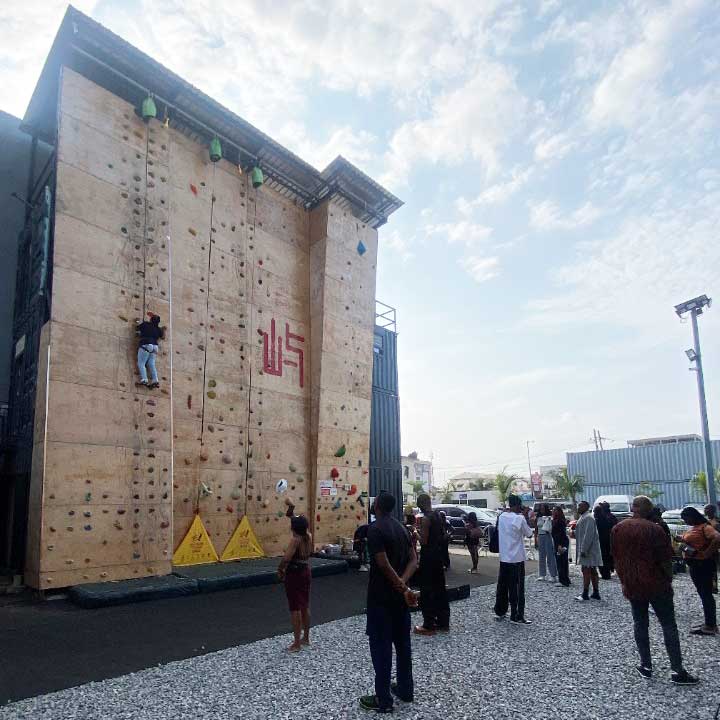
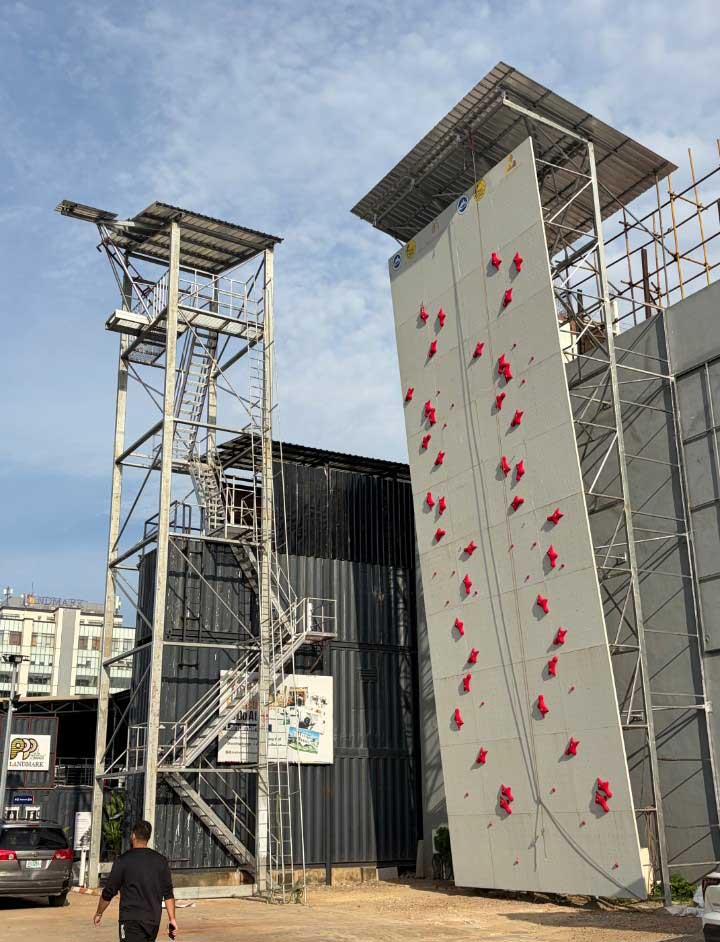
The walls themselves are built in the open air, sheltered by canopy roofs rather than enclosed in a building, which suited the site and climate. Another reason for an outdoor build was to have the walls on display, in the hopes of attracting people already at Landmark for something else. In a market where nobody was visiting a climbing gym, that is precisely the audience Weland needs.
Getting the walls into the country
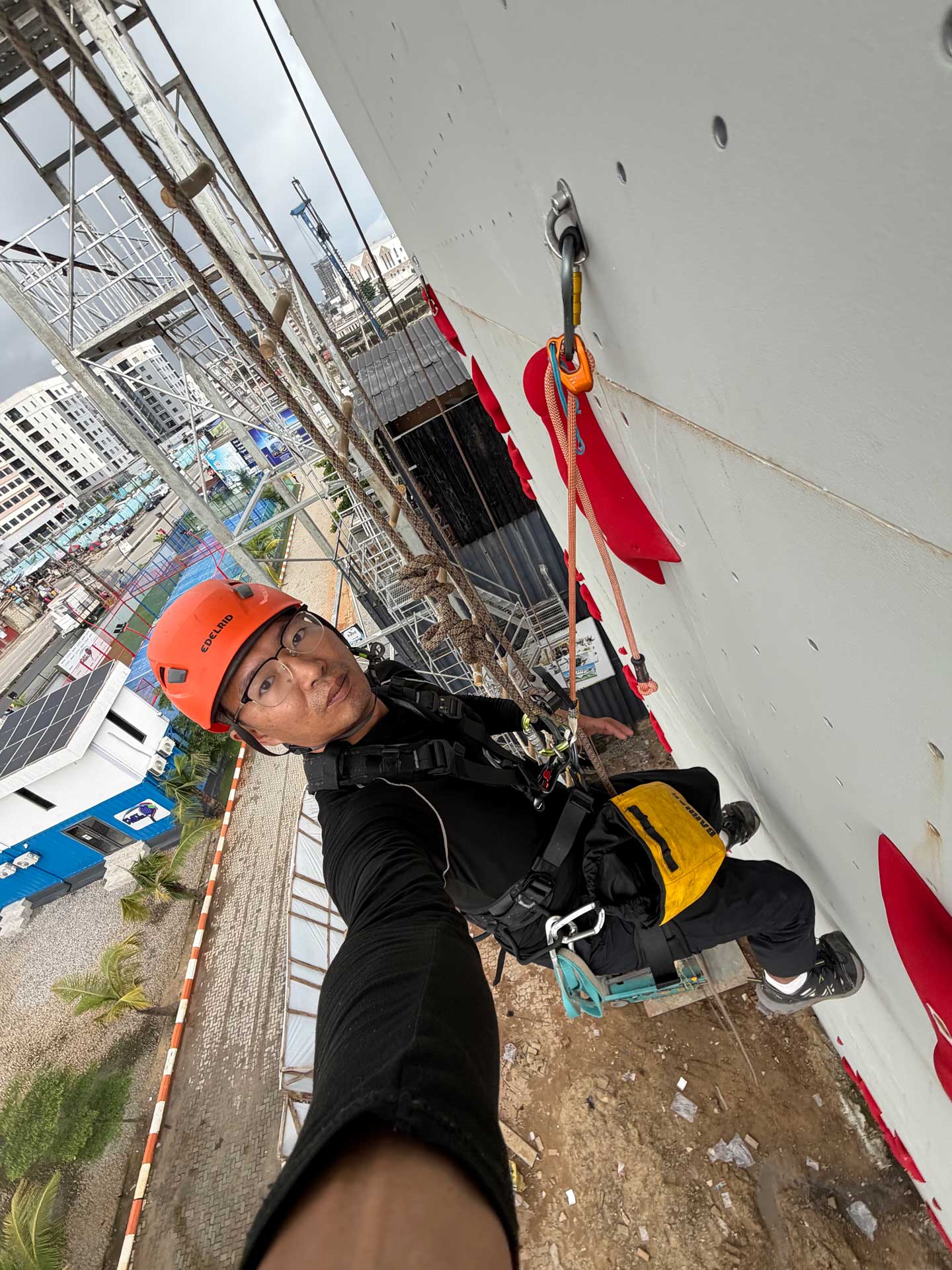
Zhang was direct about the difficulty of the build: “In fact, building a climbing wall in Nigeria is considerably more complicated than doing the same thing in China.”
The challenge is not that climbing equipment was unavailable; it is that the supply chain is more fragmented for a developer in Nigeria. “The transportation of different materials, customs clearance and coordination can be challenging, particularly because climbing manufacturers and distributors are relatively specialized and scattered across different countries,” he said.
Weland’s walls, holds and equipment came from China, the United Kingdom, the United States, the Czech Republic, France, Switzerland and Japan. To assemble those materials from Lagos, the logistics had to be treated as a project in its own right. The team bought in batches, air freighted smaller or more urgent items, and used the efficiencies they could to move the heavy material: Zhang also runs engineering projects in Nigeria with regular container shipments, so climbing materials travelled inside containers that were already coming.
That point is worth pausing on, because it is the kind that does not appear on a pro forma and cannot be assumed. An operator without an existing freight route into the country is buying shipping at market rates on a fragmented order and should model accordingly.
Zhang is equally candid that he cannot supply that number himself. “I have not kept a detailed record of the total logistics and equipment expenditures specifically for Weland,” he said. “Climbing is also my personal passion, and I have continued to invest in climbing equipment and related projects over the years, so my personal climbing expenditure and the gym’s expenditure have not always been strictly separated.”
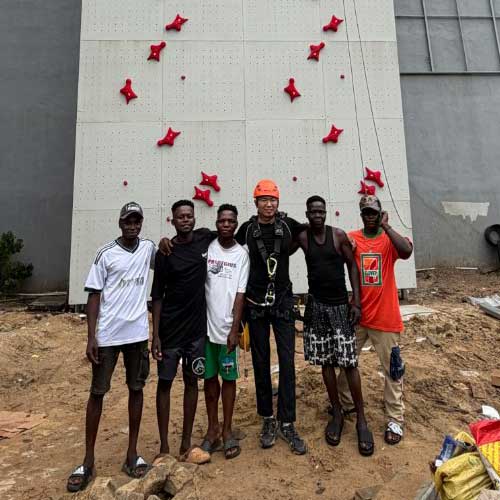
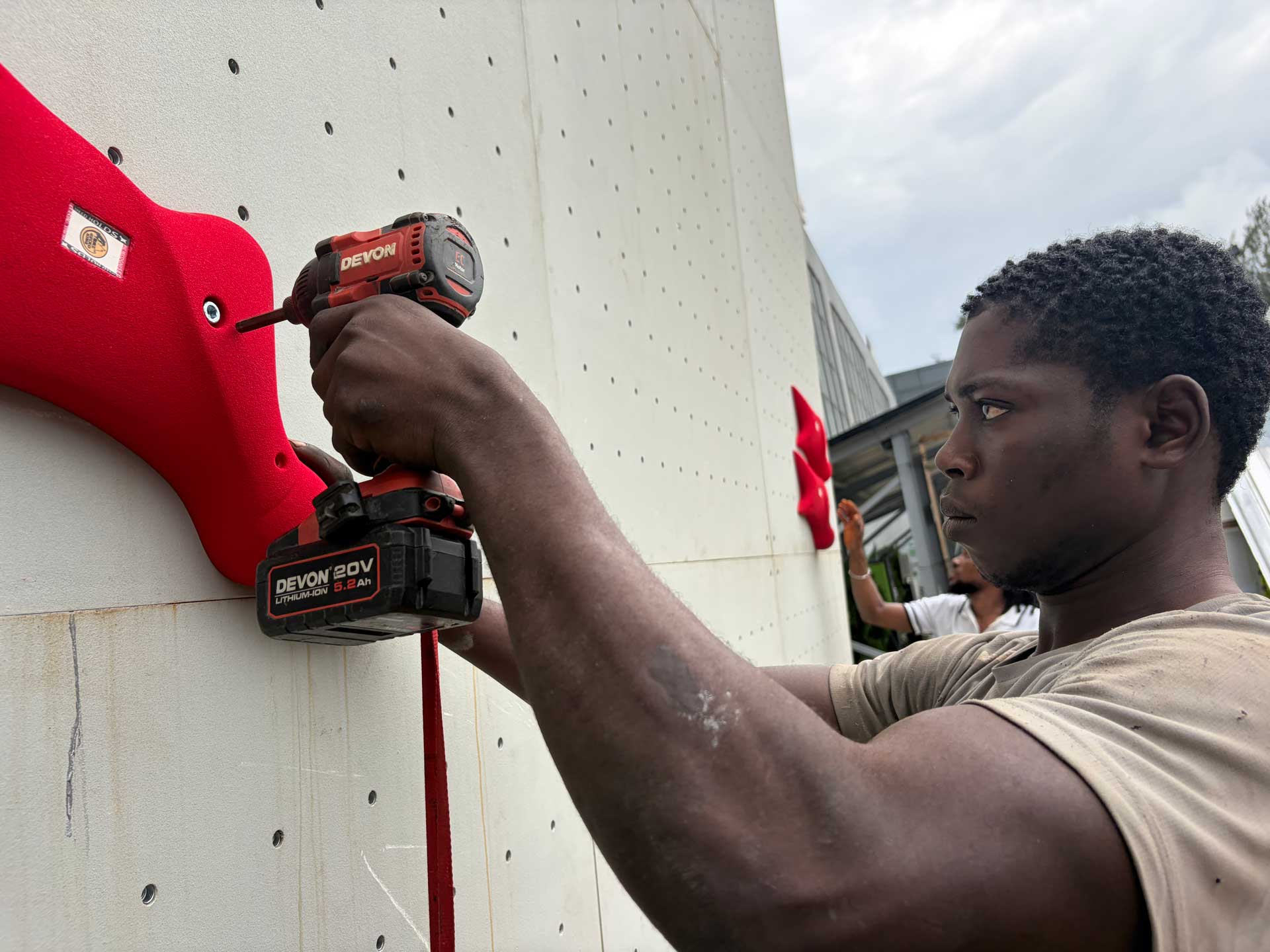
With no local installation contractors available, Zhang and his team put the walls up themselves, with help from climbers and professionals abroad. He credits the local crew for learning fast. “They have been willing to learn, and they have developed the ability to execute the work very well.”
Hiring staff in a country with few climbers
Staffing was the same problem in a different form. There was no pool of certified instructors, because there was no climbing community to have certified them.
Weland’s answer was aiming to design the risk out of the early operation rather than train it out. “Because there was no established climbing community in Nigeria from which we could recruit, we initially focused on creating a very safe and controlled environment,” Zhang said. “We introduced an auto belay system, which allowed new participants and our staff to learn the fundamentals progressively.”
The facility’s auto belays enabled beginners to climb on day one with fewer variables and let new staff members supervise before they could belay. Skills were built through daily operation rather than in advance of it.
Routesetting has not been delegated yet. Zhang sets nearly everything himself and installs most of the holds, drawing on his years of setting in China. He is clear about why he has not handed it over: “Good routesetting requires a very large movement library and continuous learning. It is not simply about putting holds on a wall; you need to understand movement, difficulty, progression, and how different climbers interact with a route.”
The longer-term plan is to send local staff to China and other countries with established climbing scenes, to bring experienced setters to Nigeria for exchanges, and to build professional training programs in climbing, mountaineering and work-at-height safety. From there Zhang wants to see Nigerian competition organizers, judges and coaches.
Factoring in maintenance from the start
Auto belays helped with resolving Weland’s staffing problem. They also created an operational risk that Zhang says is often missed by operators entering a new market, and it is worth setting out in full because it is a decision made at purchase, not afterward.
Auto belays require periodic manufacturer inspection and servicing. In North America or Europe that is a scheduled inconvenience. In a country with no service network it is a question of whether the unit can be maintained at all.
“Before building Weland, we consulted with a number of manufacturers,” Zhang said. “The challenge was that many manufacturers did not have established business or service networks in Africa, which made regular inspection and maintenance more complicated.”
Weland’s solution has three layers, and only one of them is unusual.
The unusual one is the freight route again. Because Zhang’s engineering business moves equipment between Nigeria and China regularly, units can go back to the manufacturer for professional servicing when required.
The second is training. Zhang built a working arrangement with the Chinese manufacturer and received training from them, so he can now carry out routine inspection and basic maintenance in Lagos himself, including replacing the sling.
The third is a purchasing decision any operator can copy: “We also considered the specific conditions in Nigeria when selecting the equipment. In particular, we chose auto belays with a design that makes the sling relatively easy to replace and maintain locally. This reduces downtime and makes the equipment more practical for an emerging market.”
Weland runs six auto belays: five sourced from China and one from the United States. Every wall also carries top anchors, so any line can be run on manual belay if a unit is out of service. That redundancy is deliberate. A gym whose model heavily depends on auto belays cannot afford to have one away for inspection with no fallback.
Zhang thinks the servicing gap is a business opportunity in itself. “If the number of auto belays and climbing facilities across Africa continues to grow, I believe there will be a real opportunity to establish a regional inspection and maintenance service for auto belays in Africa.”
Pricing for people who have never climbed
Weland charges ₦10,000 for an adult session and ₦8,000 for children, with gear included. Zhang set that pricing against international benchmarks intentionally, seeking to provide a community climbing space that would be as affordable as possible.
“In many markets, a single climbing session can cost around US$20–30,” he said. “When we started in Lagos, we deliberately used approximately US$5 as our pricing benchmark.”
He described the climbing operation as “essentially nonprofit in nature,” with revenue going back into the facility, the equipment, the staff and the development of the sport.
The customer pattern that has followed is not what a gym in a mature market might expect. Traditional repeat business is low, because most visitors are not climbers with a training routine. What Weland gets instead is referral. “People often come back with their friends after their first experience, or recommend Weland to their colleagues, classmates and families.”
Advance bookings are rare. Almost everyone walks in during opening hours, which Zhang regards as a feature rather than a gap. Spontaneity has helped lower the barrier for someone who has never considered climbing and is walking past the wall on a day out.
Of the more than 5,000 people who have climbed at Weland since it opened, the vast majority had never climbed anywhere before.
Why the second phase was a speed wall
Phase 1 at Weland was built for beginners—a plywood roped wall with top ropes and auto belays—and first opened early 2025. Phase 2, completed in July 2026, consists of two World-Climbing-standard speed climbing lanes on a separate wall.
That is a striking choice for a facility whose customers are mostly first timers, and it was not Zhang’s personal preference. “Personally, I actually prefer bouldering and lead climbing,” he said. The decision was strategic. Based on his understanding and Weland’s own experience, there was no other World-Climbing-standard speed climbing facility of that kind in Africa when they developed theirs, and he considers speed particularly suitable for the development of competitive athletes. Weland discussed the plan with World Climbing staff several times before building the structure. The stated goal is to help Nigerian athletes enter international competitions in the shortest possible timeframe.
The early signal has come from outside Nigeria. Athletes and climbers in other African countries have contacted Weland asking whether they can travel to Lagos to train on the wall.
Next on the plan are a dedicated bouldering facility and a more professional lead wall, along with exploration of Nigeria’s natural rock for outdoor route development.
What Zhang would tell another operator
Asked what he would say to someone weighing a gym in a market with little to no climbing culture, Zhang gave one answer about equipment and one about operations.
On equipment, the advice is procedural and immediately actionable: “For operators considering a climbing gym in markets such as Nigeria, Ghana, Kenya or elsewhere in Africa, I would say that equipment servicing and maintenance should be considered before purchasing the equipment, not after. The availability of spare parts, technical support, inspection arrangements and the ability to minimize downtime can be just as important as the initial purchase price.”
On the operational side, his answer comes back to a people-centered approach. “I would say that climbing should not be viewed purely as a commercial business. First, you need to genuinely love the sport yourself. More importantly, you need to build a climbing community. Some of the most valuable returns may not come in the form of short-term financial profit, but from the community, relationships and atmosphere that develop around the sport.”
And then the line he put above everything else: “Safety must come first. A climbing facility should be designed, built and managed by professionals. Safety awareness must always come before climbing.”
For an operator looking at a country or region where nobody climbs at a local facility yet, that is the whole proposition in miniature. The first gym in a market is not selling sessions to climbers. It is building the conditions for customers it will later sell to, one first timer at a time, and it likely has to do so without a single margin for error on the wall.