In 2026, we have more evidence than ever of the power of climbing and the reward of running a successful climbing gym business. Since the first commercial climbing gyms in the United States opened in 1987, the number of gyms in the industry has grown every year, and there are now dedicated teams at nearly 700 facilities bringing the physical, mental and social benefits of climbing to communities around the country, according to CBJ’s annual Gyms & Trends report.
Looking to build a new gym? CBJ’s Climbing Gym Market Report and Dashboard are must-have research tools for the modern day. The latest editions, fueled by updated market data for every core-based statistical area in the U.S. and CBJ’s current Gym Map data, were built to equip developers with more data-driven insights you need to make informed decisions, including:
- Confidence you need to lead your project: U.S.-wide summary statistics and analyses for validating project assumptions (detailed per-market KPIs in the dashboard).
- Insights on untapped opportunities: a list of the Top 300 markets ranked by opportunity for a new climbing gym build (full 900+ ranked list in the dashboard).
- Targeted audience research: key social, economic, demographic and housing variables for all markets plus select health data (dashboard only).
- Industry-leading tools: business leaders have been taking CBJ’s detailed data reports to the bank and seeking out CBJ’s up-to-date gym data since 2013.
Curious about the landscape for climbing gym development in 2026 and opportunities for more growth? Below are five takeaways we had after crunching the numbers for this year’s report and dashboard, as well as quick steps you can take to access them.

Access the Tools
- CBJ Premium members get them FREE: Download the report here for FREE and contact us to set up one month of FREE dashboard access!
- CBJ Plus and Pro members can purchase the report here and here ($200 / $300) and contact us for dashboard access ($500/mo / $600/mo).
- If you’re not yet a CBJ member, learn more and enroll here. Every paid level is packed with valuable benefits starting at $150/year.
Takeaway #1: Challenges Exist, But Opportunities Abound
Before diving deeper, it’s important to acknowledge the shifting economic conditions in which climbing gyms do business. Operators cited significant economic headwinds of late in CBJ’s Gym & Trends report—from continued rising costs to reduced consumer spending and fewer check-ins—and those challenges have had real consequences for gyms and climbers. But as the results of CBJ’s Climbing Gym Operators Forecast Dashboard show, those effects have not been felt the same in every region; in many places there have been opportunities to adapt and thrive, and the same conclusion stands out from CBJ’s Climbing Gym Market Report and Dashboard.
When considering KPIs like total population and per capita income, for instance, more than half of the 925 markets in the U.S. saw their latest five-year averages grow, compared to the prior five-year period (2020-2024 vs. 2015-2019, with income in 2024 inflation-adjusted dollars). In fact, over 125 markets grew by 5% or more for both indicators, and over 25 markets grew by 10% or more—including several established climbing gym markets like Austin-Round Rock-San Marcos (TX), which ranked in the Top 10 in opportunity for a new build.
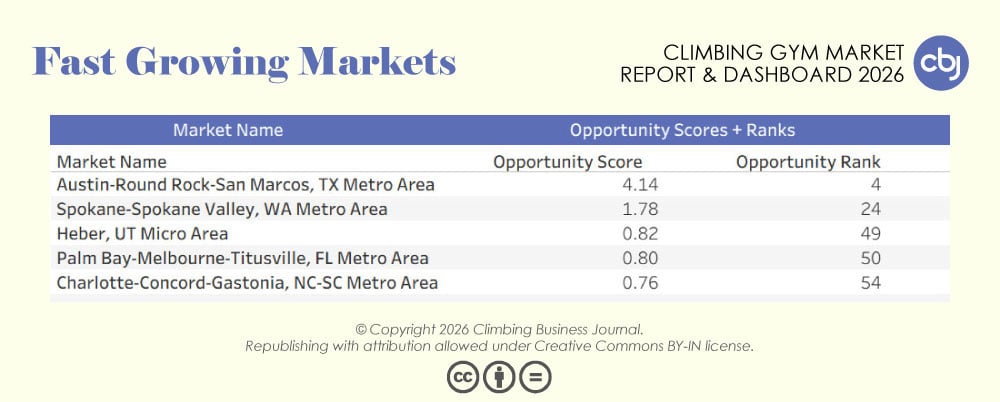
Below are five of the fastest growing markets (7.5% or more total population and per capita income growth over those time periods) with the highest opportunity scores, and more market stats for all 925 CBSAs in the country (as well as the opportunity score formula) can be found on the Markets page of the dashboard.
Takeaway #2: It’s Not Too Late to Be First to Market
Even after 40 years of development—explored in greater detail in CBJ’s Climbing Gym Industry Growth Dashboard—there are still markets in nearly every U.S. state that don’t have a commercial climbing gym at the moment. Often these markets are less populated areas, but that doesn’t necessarily mean there’s not opportunity for a facility in town. Climbing gyms come in all shapes and sizes, and new builds can be scaled to match the level of consumer demand and modeled to fit a community’s unique characteristics and culture, when the conditions are right.
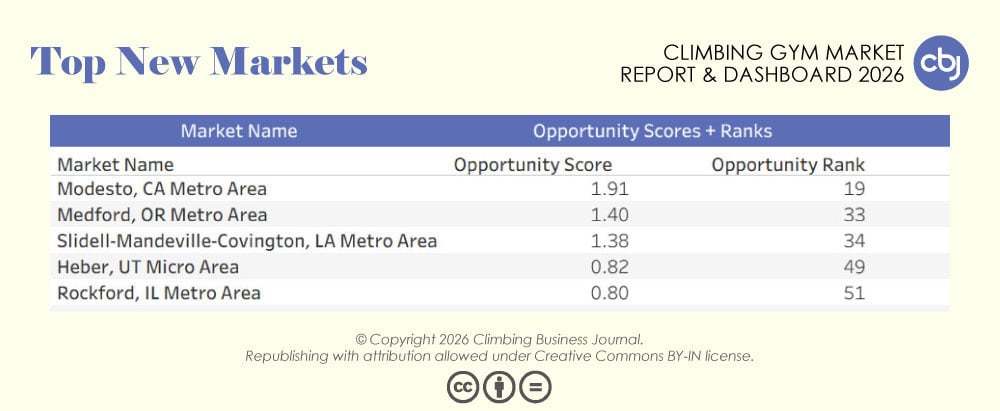
Of the Top 100 markets in the opportunity score ranking, more than half (58) have one climbing gym or less, and 33 have no climbing gym at all. Below are five of the top-ranked markets where your new gym could be the sole build in town. Every U.S. market without a climbing gym (that’s open or known to be well under construction) can be analyzed on the New Markets page of the dashboard.
Takeaway #3: Density and Opportunity Are Not One-to-One
It’s well known that places in Colorado, California, New England and the Pacific Northwest have a higher density of commercial climbing, but the Climbing Wall Density Index in CBJ’s Climbing Gym Market Report and Dashboard was the industry’s first metric to quantify exactly how much, based on a market’s total wall surface, number of gyms, population and size.
However, it’s important to not equate high density to low opportunity. Sometimes, the characteristics of a market that’s already flourishing with climbing gyms may mean it’s still ripe for a new facility, and that’s exactly what the New Climbing Gym Opportunity Score in the dashboard was built to assess. The metric incorporates multiple KPIs and uses regression analysis to see which markets may be relatively underserved at this moment in time.
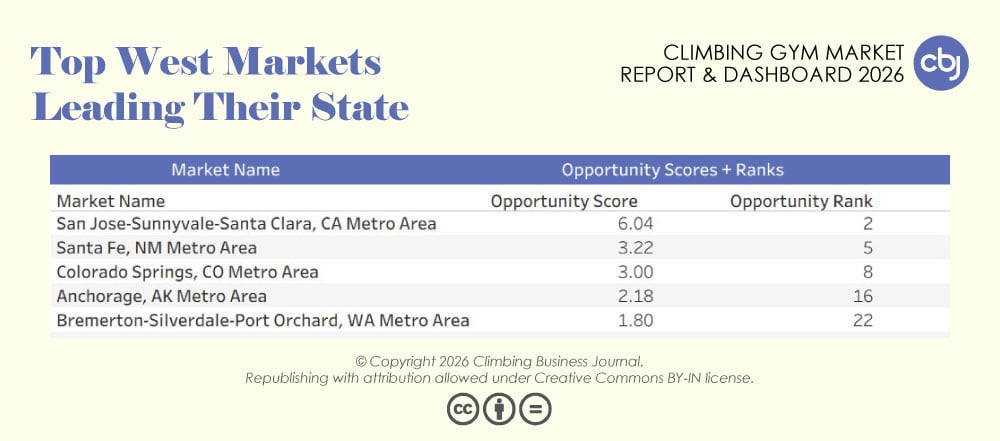
In fact, eight of the Top 10 markets in this year’s opportunity score ranking are in the West or Northeast regions, and over half (14) of the Top 25 markets are in the West alone. Below are five markets out west that led the way in opportunity for their respective state, and the full opportunity score ranking for all 925 markets can be viewed on the Opportunity page of the dashboard.
Takeaway #4: Don’t Overlook the South and Midwest
Historically, many geographically flatter areas were not viewed as major climbing destinations, without outdoor crags nearby, but that trend has changed with the introduction and proliferation of indoor climbing gyms. Today, Chicago has more than a dozen facilities, for example, and Florida has seen rapid development in recent years. CBJ’s Gyms & Trends report also highlighted how many operators in the South and Midwest have been weathering the economic conditions and, on average, headed into 2026 with more optimism compared to other regions.
When conducting research for a potential climbing gym project, be sure to not overlook less traditional climbing markets. Some places may have relatively lower participation rates for now, but there may be sufficient demand for new builds, and those figures can change with more gyms in town, as awareness of and interest in climbing grows.
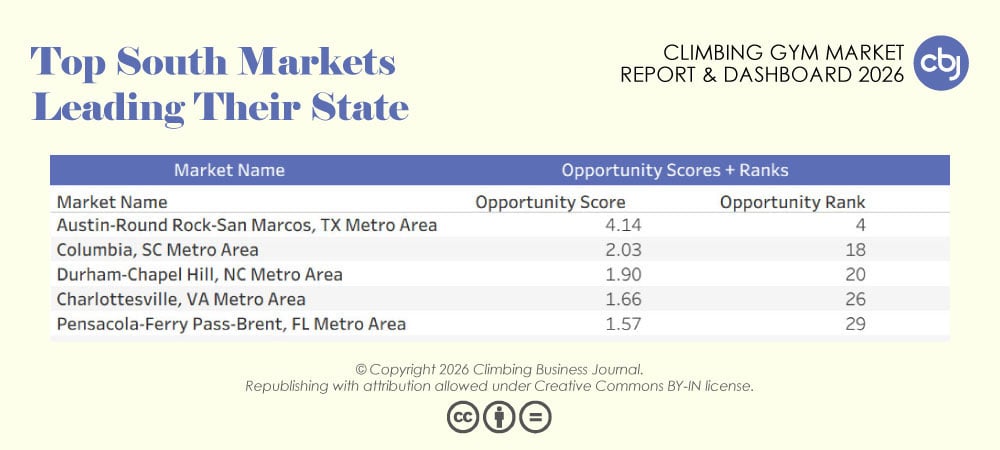
Of the Top 100 markets in the opportunity ranking, over half (52) are in the South or Midwest, and over a third (37) are in the South alone. Below are five markets down south that led the way in opportunity for their respective state in this year’s Climbing Gym Market Report and Dashboard.
Takeaway #5: New York City Is in a Tier of Its Own
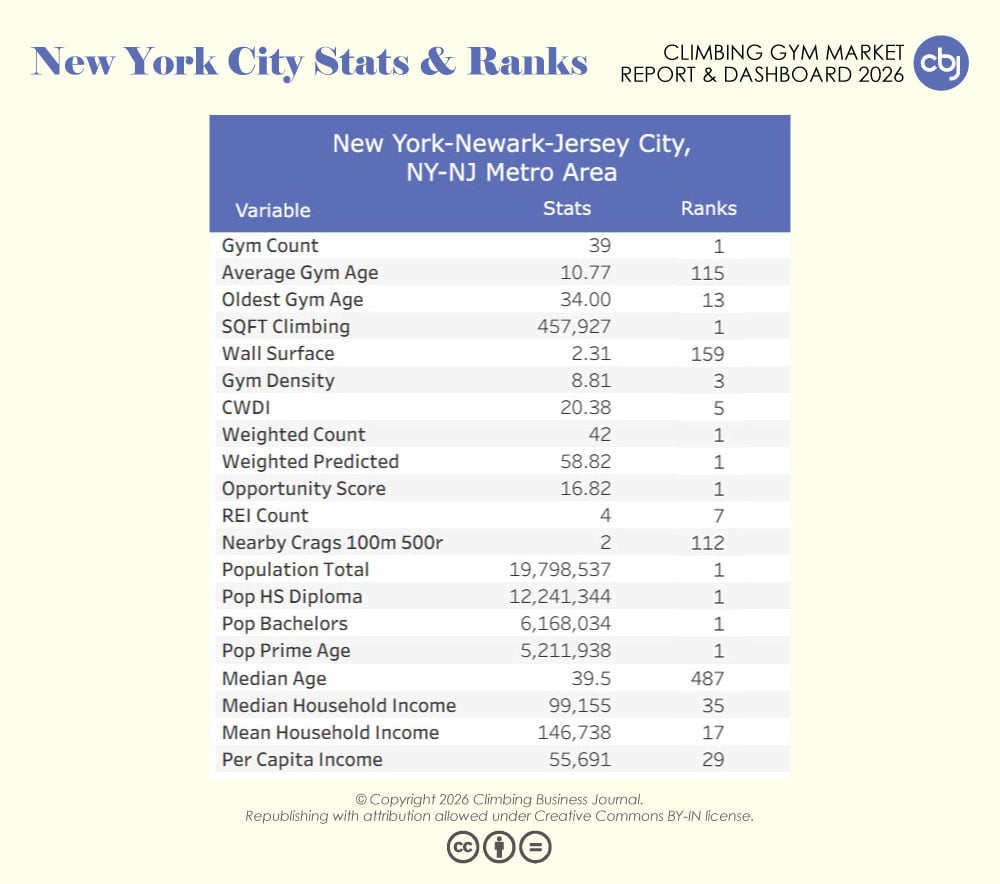
Finally, one look at the opportunity scores and it’s clear that the New York City market (New York-Newark-Jersey City) is in a class of its own. Although there are nearly 40 climbing gyms in the market already—and even though the total square feet of climbing across those facilities is above what one might expect, based on the industry average for a gym—New York City has topped the opportunity score ranking in every edition of this report.
Undoubtedly, contributing most to New York City’s high score is the high concentration of people in the metropolitan area. With a population of 19.8 million, New York City is far and away the most populous market in the country, and the highly walkable and transit-friendly city is head and shoulders above the next market in terms of public transportation use (over 24% commute to work via public transportation, compared to under 10% in every other market). It also has more people (5.2 million) within the prime age for climbing (15-34 years old) than any other market.
CBJ’s Climbing Gym Market Dashboard makes it easy to see how every market stacks up across these key gym and market stats, with rankings for each variable and a dedicated Individual Markets page for comparing one market to another, so consider upgrading to a CBJ Premium membership to unlock one month of free dashboard access.
Methodology, Limitations, Disclaimer & Acknowledgements
All the gym data for CBJ’s Climbing Gym Market Report and Dashboard was derived from the comprehensive proprietary dataset powering CBJ’s industry-leading Gyms & Trends report and Gym Map. The market data referenced in this article, and throughout the report and dashboard, was primarily derived from the U.S. Census Bureau’s annual American Community Survey (ACS) for the year 2024 and consists of five-year estimates/percentages for U.S. core-based statistical areas (CBSAs).
As with any data-based project, this one is not without limitations that should be considered alongside the results. For instance, the number of climbing gyms in a market is always a moving target, since there are continually new projects being announced and constructed or existing gyms permanently closing their doors. Like other publications, this article represents a snapshot of a moment in time, referencing data pulled from CBJ’s Gym Map dataset in April 2026, and does not reflect later changes. Furthermore, only commercial climbing gyms in the U.S. were included in the analysis, in part because more robust data was available for these facilities. In the future, information on other sites with a climbing wall and markets in other countries could be completed and analyzed.

Additionally, in breaking down climbing gyms by their respective CBSA, one drawback is that all climbing gyms in a CBSA are associated with the same socioeconomic and health data, regardless of where a climbing gym is located within that market. There are limitations to any regression-based approach, as well, including the type of regression model chosen and missing explanatory variables, which can impact the significance of the selected variables and opportunity score results. The opportunity score also does not assess how large or small of a gym a market may merit or which business model may best suit the community, and proper business planning is always needed to determine a suitable project scope. In the future, the analysis could be broken down into roped and bouldering gyms, incorporate demographic data based on smaller market segments and travel time isochrones, or leverage alternative statistical models for the opportunity score ranking.
Finally, please note that content in this article and the CBJ Climbing Gym Market Report and CBJ Climbing Gym Market Dashboard is of a general nature and is for informational purposes only. Readers should not construe any such information or other related materials as legal, tax, investment, financial or other advice. In exchange for accessing this content, the reader agrees not to hold CBJ, its affiliates or any third-party service provider liable for any possible claim for damages arising from any decision you make based on the content.
More details on the methodology, sources and limitations of the analysis (as well as a full legal disclaimer) can be found in the report and dashboard.
Special thanks to all the industry professionals who have shaped CBJ’s market analysis tools over the years—especially Joe Robinson, as well as Scott Rennak, Theresa Phamduy, Timy Fairfield, Brandi Proffitt, Jon Lachelt and many others—and the dashboard users who provided expert feedback, as well as all the CBJ members and advertisers who make our work possible.
Contribute to the Research
Got an idea for how to improve these tools, a question about the data, or a comment to share? We’d love to hear from you! Fill out the short, three-question feedback form here anytime.