If you have spent any significant time in a professional routesetting context, you have almost certainly encountered the RIC Scale. Developed by world-class routesetter and movement philosopher Tonde Katiyo—along with co-author Jacky Godoffe in their essential text My Keys to Routesetting—the RIC framework broke open the conversation around what climbing difficulty actually means. It gave the setting community a shared vocabulary, where before there was only vague gesture and gut feeling.
Risk. Intensity. Complexity. Three dimensions, each scored (often from 1 to 5) relative to the target grade and population, and each revealing something V-grades alone cannot.
For a generation of setters, RIC has been the Rosetta Stone that allows head setters to communicate meaningfully with guest setters they have never met, helps teams audit whether their circuits are stylistically diverse, and invites climbers into a richer understanding of why certain problems feel hard in certain ways.
And yet—for all its power—RIC is incomplete.
After years of applying the framework across commercial gyms, competitions, and high-level setting teams, a persistent set of gaps becomes apparent. In short, RIC essentially tells us what a climb is made of, but not whether it fits every body. It describes a single move’s character, but not how the difficulty unfolds across the arc of an entire problem. It measures the ingredients, but not the recipe.
Over the years, routesetters have incorporated other variables into the equation, and in my decades of setting I’ve observed a few that stand out the most. In my opinion, three additional dimensions—Subtlety, Equanimity and Tempo—are necessary to complete the picture. Together with RIC, these six elements of RIC-SET form a genuinely comprehensive framework for setting quality, intentional movement and accessible climbing for all bodies.
This article is written for professional routesetters who already know RIC and are ready to push further.

Part One: The RIC Scale—A Foundation Worth Revisiting
Before extending the framework, it is worth being precise about what each RIC element actually captures—because the terms are intuitive enough to invite misreading. (Further reading on the RIC scale can be found in this CBJ article, authored by Devin Dabney with Thomas Bonifield.)
Risk
In everyday language, risk implies danger. In the RIC framework, it means something more nuanced and movement-specific: the degree of commitment a move requires, and the consequences—physical and psychological—of failure. A high-risk move is one where the climber must commit their body to a position or trajectory before they know whether it will succeed. Dynos and deadpoints carry inherent risk because the hand must release the hold before the target is secured. Heel-toe cams carry risk because the body is locked into a leveraged position that can torque the knee if the foot pops unexpectedly. Mantles carry risk because the body transitions over the fulcrum point where recovery becomes difficult.
Risk is scored relative to the grade and the target climber. A coordinated leap between two large volumes might be a Risk-4 at V1 and a Risk-1 at V6. The same move asks a fundamentally different psychological question depending on who stands beneath it. Critically, Risk is not about injury potential—a setting team should never deliberately introduce physical danger—but about the vulnerability inherent in certain movement patterns. High-risk problems demand that climbers develop trust in momentum, body flight, friction and uncertainty.
Intensity
Intensity is the dimension most closely aligned with what most climbers mean when they say a problem is “hard.” It measures the pure physical demand of the movement: how much force is required to hold a grip, how explosively a climber must generate power for a move, how much tension must be maintained through the core or shoulder during a long lock-off. Intense problems “punish” physical weakness. They are the problems that feel desperate for the grade—the ones where you squeeze harder, pull harder, and your forearms are on fire before you even think about sequence.
Intensity can also manifest as sustained effort across a problem—not a single powerful move, but a succession of moderately demanding moves that accumulate fatigue into a crux. A problem can be intensely powerful in one burst or intensely endurance-focused across many moves. Both register as high Intensity but feel completely different in the body. Importantly, Intensity also interacts with the other RIC dimensions: as Thomas Bonifield and other experienced setters have noted, Risk requires a baseline of Intensity to function properly—if the catching holds are too difficult to grip, a climber cannot execute the dynamic move in the first place.
Complexity
Complexity is the puzzle. It is what draws so many people to climbing in the first place—the sense that the problem is a question the setter has posed, and climbing is the act of answering it. A complex problem asks the climber to find the path through an unfamiliar configuration of holds, orientations and positions. Complexity is often interpreted at two scales:
Macro complexity is the overall sequence—the arrangement of holds that generates the use of creative, non-obvious solutions to complete the problem. Does the climber need to use an outside flag, toe hook or backstep for balance? Is the move better executed as a cross through or a recycle? Is there an unexpected rest position or secret beta that can only be discovered by exploring the wall, not read from the ground? Macro complexity is primarily the setter’s domain, built into the structure of the problem.
Micro complexity is smaller and sometimes invisible from the ground: the precise hip angle that unlocks a move, the exact rotation of the shoulder that allows a climber to reach a hold, the direction of swing that creates the right trajectory for landing a laché. Micro complexity rewards experience and body awareness. Climbers who can read and execute micro beta often move through problems that feel significantly harder than their grade to those who cannot.
All three RIC elements interact with each other in dynamic ways. A high-complexity problem with very low intensity allows time for solving the problem mid-route. A high-intensity, low-complexity problem is a test of pure physical output. The most interesting problems—the ones that climbers remember for years—usually balance all three factors with deliberate craft.
Part Two: Three Missing Keys
RIC is an excellent diagnostic tool for assessing move character. But, in my opinion, it is largely agnostic to the body, agnostic to fairness across body types, and agnostic to the temporal shape of a problem. The three elements below address exactly these blind spots.
Subtlety
Subtlety is closely related to micro complexity but deserves its own dimension because it describes a specific and distinct quality of movement: the degree to which success is dependent on hyper-specific positional or tactile information that is not intuitive, is not readable from the ground, and may not even be articulable by the climber who solves it.
A subtle move might require an extreme positional commitment that must be precisely correct—a barn-door counter so severe that the climber must be nearly horizontal before the opposing foot can find purchase and arrest the swing; half a degree off in body angle and the position collapses.
Another form of Subtlety lives in the hold itself: a shaped surface with an irregular, geologic or abstract patterned texture; blockers forcing an exacting grab position; an asymmetrical pocket, or a pinch with one grippy face and one slick one. The climber must discover not just where to put their hand or foot, but at what angle, with what thumb orientation, applying pressure in which direction, etc. The hold only works best in one specific way, and the margin for error is tiny.
Subtlety differs from Complexity in that it cannot be unlocked purely through reading, experimentation, or sequence logic. It often requires tactile feedback, body proprioception, or extensive trial and error on the wall—and sometimes even successful climbers cannot fully explain what they did. Where Complexity rewards problem-solvers, Subtlety rewards body awareness and movement sensitivity. A problem high in Subtlety and low in Intensity is not physically hard but may take dozens of attempts because the climber is chasing an elusive position rather than developing strength.
For setters, tracking Subtlety is important because it affects who a problem is actually fair to. Subtle movements are often learned movements—they favor experienced climbers with rich movement libraries and attention to detail. At accessible grades, high Subtlety can create frustrating, opaque problems that feel broken rather than challenging. At advanced grades, Subtlety becomes one of the most rewarding qualities a problem can have, demanding a quality of movement attention that separates the merely strong from the truly skilled climbers.
Like the core elements of Risk, Intensity and Complexity, the scoring of the Subtlety component can be done on a scale from 1 to 5, with 5 requiring the most precision and sensitivity.
Equanimity
Equanimity is perhaps the most critically underserved concept in routesetting—and the most consequential for inclusion. It asks the question: is this problem fair to all bodies, or does it quietly give an advantage or disadvantage based on specific physical characteristics?
Every setter knows the feeling of watching someone dyno past a crux because their long arms trivialize the span, or watching someone shorter be forced to campus a section because a critical foothold is below their accessible range for the body position required. These are not fringe concerns. They are structural features of routesetting that, when unexamined, silently skew who climbs well in a gym or competition and who does not. Equanimity is the metric that forces that examination.
Equanimity can be assessed across three primary axes: Height affects reach distances, accessible footholds and rest positions. A span that is a full lock-off for a 5’4″ climber may be a casual pull for someone 6’2″. An Ape Index differential compounds this math further—a climber of average height with a long reach occupies a completely different biomechanical reality than a climber of the same height with short arms. Flexibility introduces a third axis: a climber who can high-step into a position that brings their hip to shoulder height accesses a fundamentally different version of a move than one with moderate hip flexibility.
High Equanimity does not mean that every climber will find every move equally easy—that is impossible and not the goal. It means that the difficulty is relatively balanced: that a tall climber’s easier span is offset by other features of the problem, or that an alternative sequence exists for shorter climbers that demands different but equivalent effort. Low Equanimity means the problem has an unexamined bias—it may be substantially easier or harder for specific body types, not as a product of skill or effort, but simply of anatomy.
A note on Equanimity and “broken beta”:
One of the clearest hallmarks of high Equanimity is the distinction between forced options and forced movement. Forced movement—the condition routesetters typically invoke when warning against “breaking the beta”—describes a problem with essentially one valid solution: a single sequence that all climbers must execute in roughly the same way, regardless of their body. The concern is understandable, but the framing is often too narrow and commonly results in imbalance.
For example, a taller climber might reach a hold while staying established on a low foothold that a shorter climber has to hop or spring off from in order to reach the same hold, or consider a case where a shorter climber can more comfortably scrunch into a smaller box of body position where a tall climber finds more extreme difficulty compressing into the same space, or maybe a kneebar that only fits a specific chin-dex length. In my experience, masterful setters understand that the most equitable problems are precisely the ones that resist a single prescribed path, and climbers of different anthropometry find radically different approaches and yet arrive at the next hold having spent a genuinely similar amount of effort.
Forced options are the architecture of this experience: the setter has designed not one solution but a field of solutions, each valid, each demanding, and none dramatically easier or harder than the others. On this basis, the concept of “broken beta” deserves a more precise definition. An alternative solution only truly breaks a problem when it is dramatically easier than the intended sequence—when it circumvents the challenge rather than reinterpreting it—or when it is realistically available only to climbers within a narrow band of specific body proportions, which is itself a form of inequity. A problem that can be climbed beautifully in three substantially different ways by three very different bodies within an insignificant variation in difficulty is not a problem with broken beta, in my opinion. It is a problem with high Equanimity, and that is exactly the goal.
Tracking Equanimity across a circuit is one of the most powerful tools a head setter has for helping build a gym culture of genuine inclusion. If all problems in a gym or competition set are high-Equanimity, climbers of varied body types will progress at similar rates. If the circuit is systematically biased—say, toward taller climbers with long arms—you will see consistent grade inflation or deflation as well as scoring ties along anthropometric lines. Equanimity gives that pattern a name, and names can often be where change begins.
Like Subtlety, Equanimity carries an expressed value between 1 and 5. Problems that fit all body types are closer to 5, while a climb that is considered highly “morpho” might be a 1. Don’t mistake a climb with a low Equanimity score as a “bad” or invalid climb. Sometimes morpho is super cool if it happens to fit you or as a way to train weaknesses; it just doesn’t belong in a competition set.

Tempo
Tempo is the temporal architecture of a problem. Where RIC describes individual move character, Tempo describes how difficulty unfolds across the entire sequence—the rhythm, pacing and shape of challenge over time. It is, in musical terms, the difference between describing the notes and describing the phrase.
Think of any boulder problem as a sequence of moves, starting from the sit or stand position (Move 0) and proceeding through each hold transition—Move 1, Move 2, Move 3, and so on through the top. At each move, a relative difficulty exists. Tempo is the shape that forms when you plot those difficulty values across the sequence. That shape tells you something profound about what the problem is really testing.
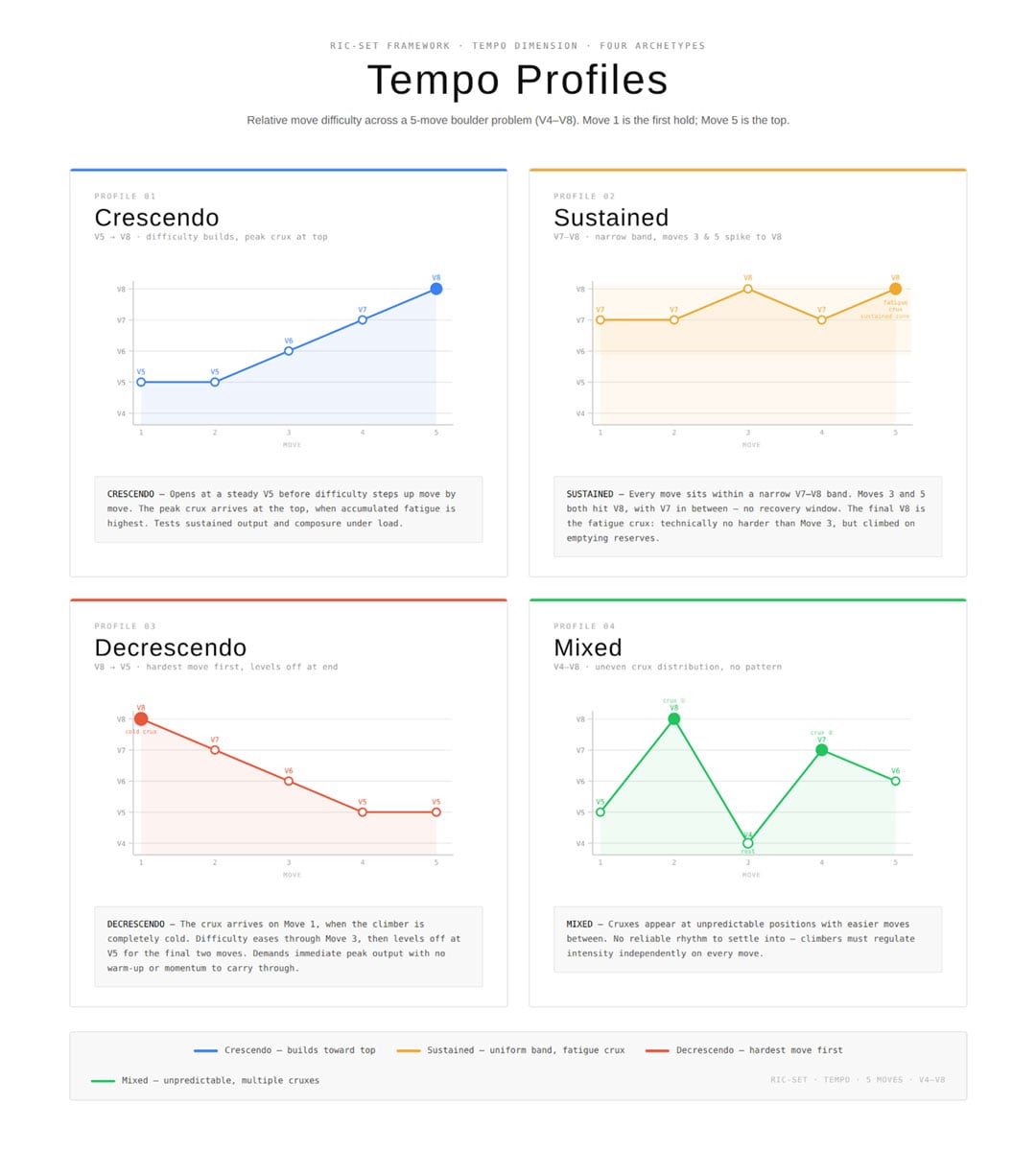
There are primarily four archetypal Tempo profiles:
Crescendo. Moves get progressively harder as the problem continues. The climber is relatively fresh at the beginning and meets the hardest challenge at or near the top. Crescendo problems test whether a climber can execute their most demanding movement under the accumulating weight of physical and mental fatigue. Many of the greatest competition boulders in history follow this arc.
Sustained. Every move is of roughly equivalent relative difficulty. No single move stands out as the crux—instead, the crux emerges from accumulation. The climber is still moving at full effort when they top out. Sustained problems test endurance, recovery, and the ability to maintain form under fatigue. They often feel “fair” on individual moves but brutal in totality.
Decrescendo. The problem opens hard and relaxes as the sequence progresses. The crux is at or near the start. These problems demand that climbers execute their most difficult movement when they are completely fresh and mentally sharp—a different psychological test than hitting the crux pumped. Decrescendo problems often feel satisfying once broken through and are well-suited to training power on specific movement patterns. In a competition setting, a Decrescendo sometimes makes it harder to achieve separation among competitor scores, but that issue can be mitigated, for example, when the start of the problem is higher in intensity while subsequent moves are technically easier but carry significantly higher levels of risk or complexity.
Mixed. Difficulty alternates unevenly—for instance, the problem could have a hard move, a moderate rest move, another hard move, several easier moves, and a crux at an unexpected location. Mixed Tempo is the most unpredictable and often the most interesting profile, demanding that climbers regulate their intensity dynamically rather than committing to a single sustained effort strategy.
Tempo can be visualized directly using a simple two-axis graph. The horizontal axis tracks move count: starting position (0), first hold (1), second hold (2), and so on through the top. The vertical axis tracks relative difficulty at each move, expressed in whatever grade scale the setting team uses—V0 through V17, a 1-10 difficulty index, or the team’s own internal rubric. Plotting each move produces a curve. That curve is the Tempo signature of the problem.
When a head setter maintains Tempo charts across a circuit, patterns often emerge. A gym that consistently sets Crescendo problems trains climbers who excel under fatigue but may struggle with cold, technical cruxes. A gym that over-relies on Decrescendo problems trains explosive power but may lead to climbers who fall apart on sustained routes. Tempo awareness allows a setting team to deliberately vary the dramatic shape of their climbs—to offer not just different hold types and movement styles, but different rhythmic experiences of effort and release.
On sport routes, Tempo becomes even more consequential. A technical 5.12b might have a Mixed Tempo that demands constant recalibration, while a harder 5.12d with a Decrescendo profile may be psychologically more accessible because the crux comes when the climber is rested and confident. Tempo helps setters and coaches understand why a route “punches above its grade” or “climbs easier than it looks.” Often the answer is not in the individual moves, but in their arrangement.
Unlike the other elements of RIC-SET, as previously mentioned, Tempo can be expressed as a curve on a two-axis graph as opposed to a rating from 1 to 5. This graph can be a quick sketch of a squiggled line on a whiteboard, or it can be an in-depth tracking and analysis of difficulty move-by-move—whichever works for the situation. Here are some basic examples of what a Tempo chart might look like for a 5-move boulder problem:
Part Three: The Complete RIC-SET Framework
When all these six dimensions are brought together, they can form a comprehensive diagnostic tool for any boulder problem or route. RIC—Risk, Intensity, Complexity—describes the character and demand of individual moves and sequences. SET—Subtlety, Equanimity, Tempo—describes how those moves are experienced, by whom and across the arc of the whole problem.
Together, the six dimensions answer six distinct questions that qualified routesetters should be able to answer about every problem they build:
Risk: How much commitment does each move demand, and what are the consequences of failure?
Intensity: How physically demanding is the movement, in terms of strength, power and endurance?
Complexity: How much puzzle-solving—at macro and micro scales—does the problem require?
Subtlety: How dependent is success on hyper-specific body positioning or tactile hold information that cannot be read or fully articulated?
Equanimity: Is the difficulty balanced across different body types—height, ape index and flexibility—or does the problem systematically favor certain anatomies?
Tempo: How is difficulty distributed across the sequence of moves—crescendo, sustained, decrescendo or mixed—and what does that shape ask of the climber?
These six dimensions are not merely analytical abstractions. They are practical tools for a setting team’s communication, circuit auditing, and deliberate design. When a forerunner completes a new problem and reports back, an RIC-SET framework gives the head setter a rich and actionable account of what that problem is and whether it serves the circuit. When a team is setting a competition, the framework allows setters to check that no two problems in a round share the same profile—that the boulders demand genuinely different climbing varieties, genuinely different skills, and genuinely different kinds of excellence.
Toward Richer Setting
Tonde Katiyo built something remarkable with RIC. He gave a profession that barely existed—professional indoor routesetting—a language for talking about what it does. That gift should not be taken for granted. The most experienced setters in the world still struggle to communicate grade nuance, and RIC is the best tool that exists for bridging that gap.
But the discipline continues to mature, and the questions it faces are growing more complex. Who is climbing for? How do we build for the full spectrum of human bodies, not just the archetypical climber? How do we craft problems that tell a story, not just test a threshold? How do we understand why a problem feels the way it feels—not just on a single move, but across the whole experience of climbing it?
Subtlety, Equanimity and Tempo are not replacements for RIC; they are natural extensions to it—the dimensions that become visible once a setting team has internalized the original three and is ready to ask harder questions. Used together, all six dimensions can form a framework capable of supporting a fuller ambition of what professional routesetting can be: a practice that is simultaneously athletic design, embodied art, inclusive engineering, and—at its best, I would say—a kind of ongoing, silent conversation between the setter and every person who steps onto the wall.
The RIC Scale is only half of the story. It is time to tell the whole thing.
Further Reading
My Keys to Routesetting, Katiyo, T. & Godoffe, J., 2017
The RIC Scale, and How to Use It in Your Routesetting Work, Climbing Business Journal, May 2022
Setting Versatility Using the RIC Scale, ASCEND Climbing
EP 41: Tonde Katiyo (Part 2) — RIC as a Tool, The Nugget Climbing Podcast, October 2020
“Grades Are Dead, Long Live Grades,” willhammersla.com, March 2022