Modern indoor climbing walls have often shared a familiar look: light off-white colors, high contrast, with bold swooshes, swirls or ripples of bright colors.
Since the late 2000s, many gym owners and operators have turned to these designs to stand out from the concrete and faux rock designs of the earlier era; routesetters largely applauded the switch from concrete to wood, as it opened a new creative world of possibility for screw-on holds and volume placement.
For more than a decade, these bold walls became a staple at a plethora of new gyms, in North America and beyond. Then came the clean wood look of the 2010s, beautiful and minimalistic. Colors still persisted, but often in splashes of orange, blue or yellow accents, a style borrowed in part from interior design practices.
The team at Montréal-based OnSite was quick to notice these design trends proliferating around the industry and how they’ve been changing. OnSite CEO Francis Larose says for the most part it seems like gym owners only have two options these days: bold or clean.
“The industry is stuck in the same look and feel and vibe and color scheme for the last five to six years,” says Larose. “Everyone is doing things that are similar to the natural black or birch look.”
OnSite has been one of the proponents of this style—clean black lines, birch panels and a minimal aesthetic—leading the charge, and now the team is ready to push things forward again. Over the years, they have built their reputation on being a brand that sparks inspiration, aesthetic innovation and forward momentum.
“We are pushed to give a new option to shake it up,” Larose continues, “[to] create a new narrative, a new option.”

A Design-First Mindset at Its Core
Larose and his coworkers aren’t content for OnSite to be just another climbing wall builder. They define themselves as a “design-first” company, and it shows in every stage of their work—from initial concept sketches to final installation. Their philosophy rests on a simple principle: great design enables great performance.
This approach gives climbing gyms more than just walls—it helps them establish a unique identity. Rather than offering one-size-fits-all solutions, OnSite collaborates deeply with clients to develop climbing environments that align with the client’s brand and vision. That process involves a close collaboration with gym owners, from aesthetic choices to functional details like texture levels.
“We’re not interested in cookie-cutter solutions,” says Loi Duong, OnSite’s Marketing Director. “We work with people who care about design, who don’t want something cheap and fast just to fill a space.”

Built for the Modern Gym: Form and Function
While OnSite’s wall appearance makes an immediate impression, wall designer Alex Whiteley is quick to point out that the company’s focus on innovation goes deeper than looks.
“We understand that it is becoming more and more difficult for climbing gym operators to distinguish themselves from their local competition, especially when it comes to wall design,” says Whiteley, noting how both aesthetics and functionality come into play.
In the past, manufacturers often tried to differentiate the appearance of their walls by adding certain surface veneers or layered laminates. Those approaches, however, sometimes came at the expense of durability and usability: decorative finishes can become delaminated, warped or chipped, and some designs can limit where setters are able to drill or screw on holds.
The team at OnSite is determined to avoid those pitfalls and tradeoffs between form and function. Lately, they’ve been building framing that is structural—part of the wall’s integrity—and solid-wood panels that are functional from edge to edge. When interacting with OnSite’s latest creations, routesetters can screw holds or volumes anywhere, without fear of damaging the wall or hitting hidden steel beams.
“For setters, that flexibility is huge,” Duong says. “You’re not stuck working around odd wall angles or awkward breaks in the paneling. You can create whatever movement you want.”

From Setting Trends to Reimagining Them: the NKD Wall
When OnSite first introduced its sleek modern aesthetics, the trend the team was advancing gained traction for a reason. Bigger, cleaner panels gave routesetters more flexibility to utilize volumes and macros to transform the terrain in the way they wanted. Sleek black-and-birch palettes helped problems and routes to stand out rather than get lost in a patchwork of colors. And there were absolutely no curved panels—a bane of every setter’s existence.
The proliferation of that trend and OnSite’s success, however, created a new challenge: With so many gyms turning to similar styles of walls, what innovation could help gyms differentiate themselves from the pack?
“The industry doesn’t necessarily need innovation,” says Duong. “But our clients want options that help them stand out. When every gym looks the same, it’s harder for owners to tell their own story.”
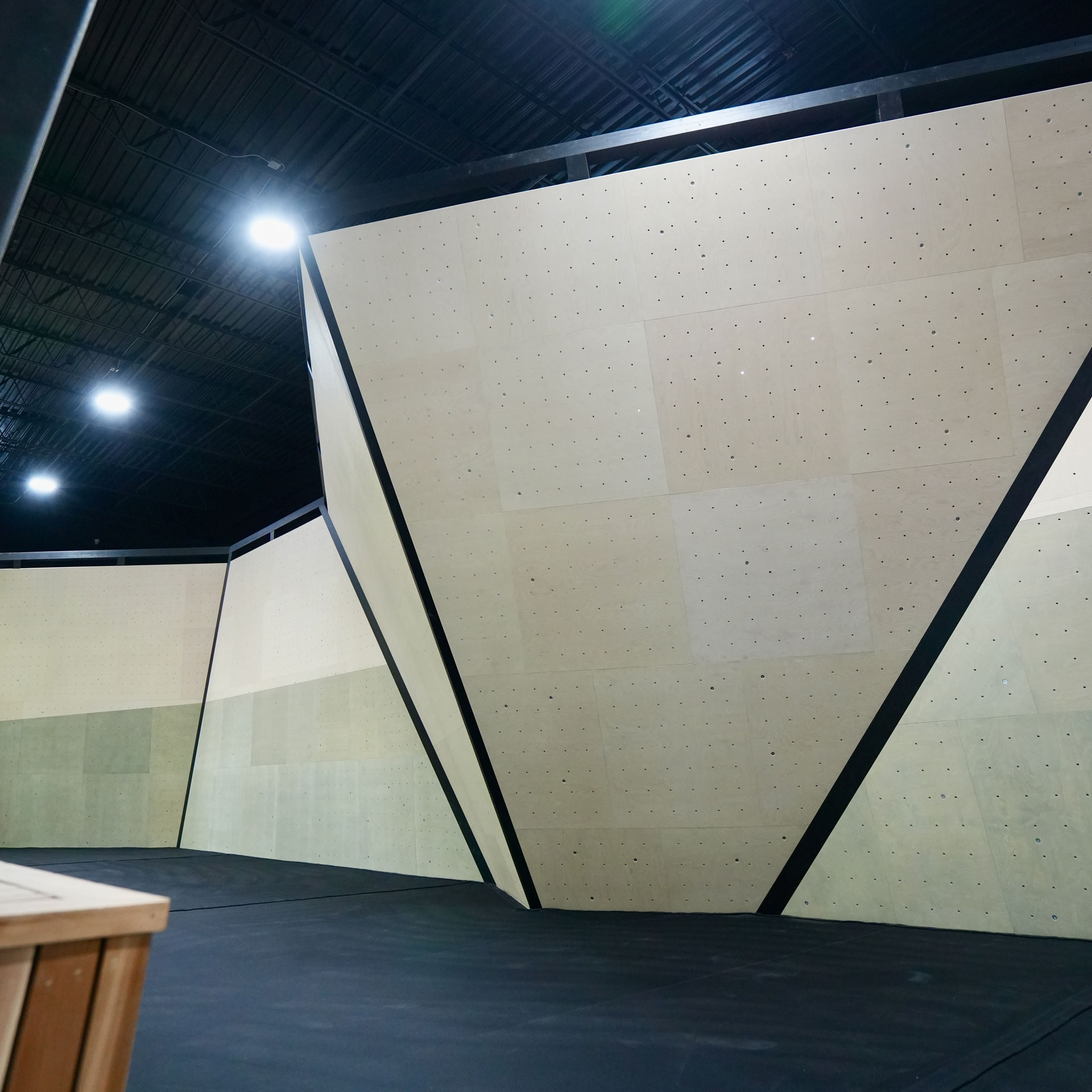
The NKD Wall is OnSite’s answer: a bold rethinking of the structure and aesthetic of their climbing walls that brings the visual framing into the design itself. The NKD wall has solid wood beams and a stained frame in colors of the client’s choice between each section of wall, creating a striking grid-like geometry. And the panels inside those frames are uninterrupted, giving setters a wide, blank canvas.
“By bringing the structure forward, the beams of solid wood provide great durability and usability, and as it is one solid piece there is no risk of delamination,” says Whiteley. “Setters can screw holds directly into them, providing a solid and secure connection point.”
“Gym owners no longer need to choose between bold and clean designs,” adds Larose. “With the NKD Wall, they can have both.”
The first NKD Wall installation at Klimat’s new gym in Ottawa, Ontario, is set to open soon. It’s an ideal showcase of the concept, with clean black framing, warm natural wood panels and wide planes ready for creative setting. Photos from the build have already been drawing attention on social media, hinting at the kind of buzz this design can generate.
For gyms looking to position themselves at the forefront of the climbing community, providing that kind of wall experience can be as important as route quality or amenities. The NKD Wall is designed to make a statement before the first hold is even gripped.
As more gyms seek ways to stand out, OnSite is betting that aesthetic innovation will be just as important as functional performance. The NKD Wall is their latest push to drive both forward—but it’s unlikely to be their last.
“Innovation has always been part of our DNA,” Duong says. “We’re constantly asking: ‘How can we make something better? How can we make it more beautiful without making it less functional?’ That’s the challenge we love to solve.”
This story was paid for by the sponsor and does not necessarily represent the views of the Climbing Business Journal editorial team.