In the past several years, many resources have emerged for routesetters hoping to improve their skills, earn credentials and bolster their resumes. In North America alone, for instance, examples of these new developments have included the Climbing Wall Association’s Routesetting Guide and Professional Routesetting Program; the annual Setter Summit hosted by The Front Climbing Club, Vertical Solutions and Proxy Climbing; Climbing Business Journal’s educational Setter’s Only webinars, hosted by Vortex Routesetting, and The Impact Driver Podcast, hosted by Holly Chen, which are focused entirely on routesetting; and CBJ’s annual Routesetting Trends report, among dozens of other routesetting-related articles at CBJ.

But many of those aforementioned resources are largely aimed at routesetters who already have a knowledge base and a degree of experience in the field. In other words, there are a lot of resources available for people who are on the routesetting career track. What about people who are at the very beginning of their routesetting journey? And what about other professionals working at climbing gyms who think routesetting might be an enjoyable and fulfilling career to transition into but aren’t exactly sure how (or where) to test that hunch? Structured certification programs like the CWA’s PRS Levels are of course an ideal pathway, but what if there’s not a course coming up near you yet and you can’t afford to travel far?
To better explore the introductory realm of routesetting career development, CBJ enlisted the help of Steve Neff, Director of Routesetting for Philadelphia Rock Gyms, Inner Peaks and Hudson Boulders. Over the years, Neff has spearheaded countless routesetting programs and initiatives for the staff at those gyms, and here he offers thoughts and wisdom on five initial steps that can be helpful to take when getting started as a routesetter.

STEP 1: Understand the difference between climbing and routesetting
A first step to becoming a routesetter is more like a pre-step, but it’s vital in the process—and it is largely a matter of self-reflection. Anyone interested in the routesetting craft should be climbing a lot and constantly asking, “Is routesetting right for me?” While climbing, would-be setters should analyze and scrutinize the routes and the holds to figure out why the holds are arranged the way they are. (What is the intended crux? What message was the routesetter trying to convey? What aspects of the route make it feel particularly easy or difficult? etc.)
Additionally, if you envision yourself in this scenario, you could experiment with different moves on the routes and play climbing games with your friends (like add-on, in particular). As you interact with the routes in different ways, note how you might be able to skip certain holds that other climbers are unable to skip. Although there is no universally recognized climbing skill level that’s required to be successful as a professional routesetter, Steve Neff cites V6 and 5.12+ as decent targets, since those grades (and above) will likely expose you to most of the techniques you will need for crafting movement. Most importantly, internalize the fact that routesetting entails making climbs for strangers—not just for yourself and your friends.
Neff says: “You need to understand what your strengths are on the wall—and how those strengths will relate to the routes/boulders you’ll be creating. The goal in commercial sets, by and large, is to create climbs that can be climbed by many different people (adults, kids, elderly, etc.). All those climbers might have different wingspans, hand sizes, endurance, etc. Also, consider that a relationship with routesetting will greatly affect your relationship with climbing. You’re not the person just solving problems anymore; you are the “puzzle master” creating problems to be solved. As a routesetter, your passion for climbing might feel like work sometimes—and you will have to be okay with that.”

STEP 2: Get your foot in the door
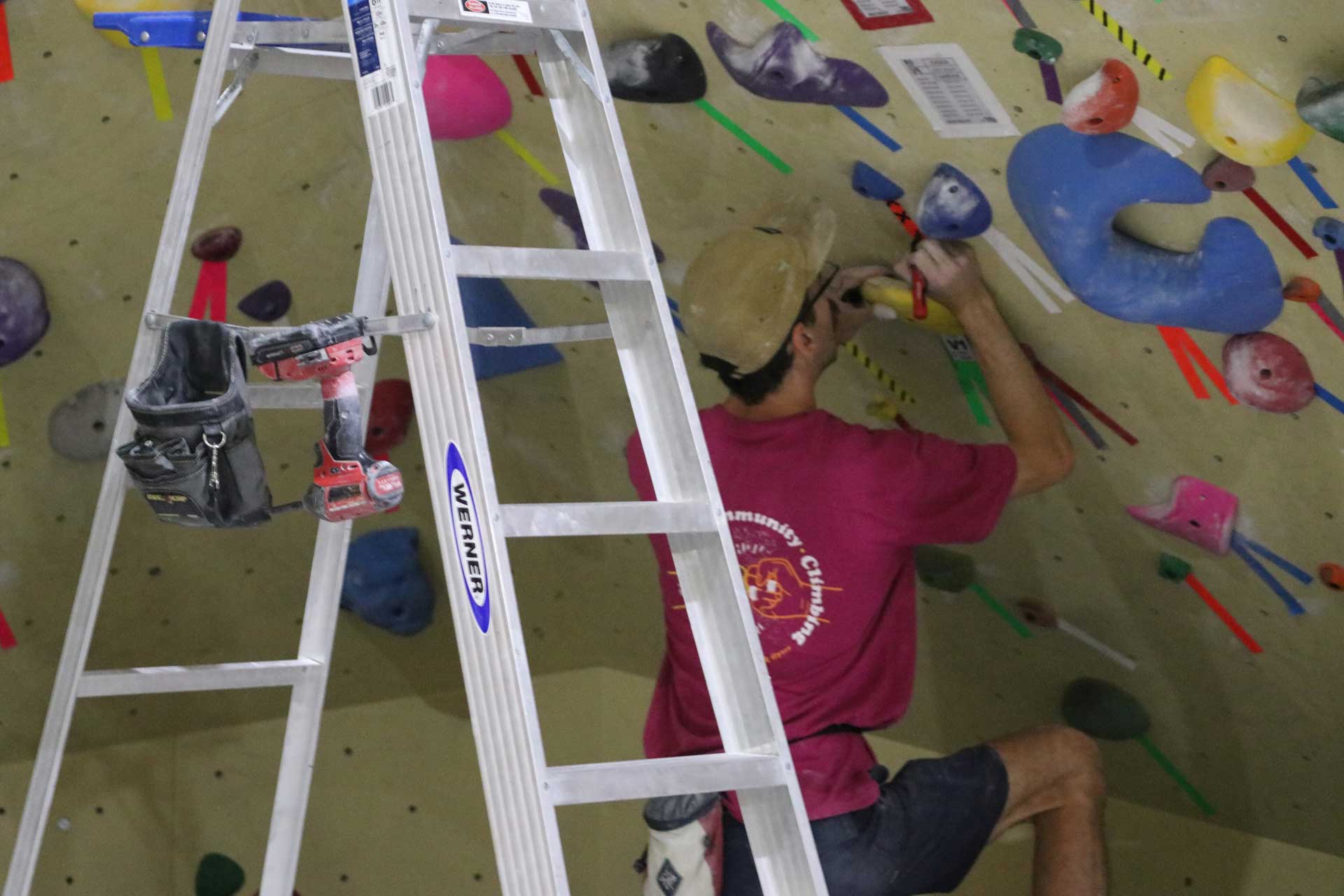
Once you spend some time pursuing the aspects and self-reflection in Step 1, look to do some actual routesetting. Often a great place to start is giving routesetting a try in a low-pressure, non-commercial setting first. If you don’t have a homewall yourself, consider reaching out to your climbing friends to see if they would be willing to let you screw or drill some holds into theirs (with proper personal protective equipment, of course). Homewalls are a great place to cut your teeth into the craft, learn some mechanical basics, and help you walk into a climbing gym with a few skills in hand first.
After you’ve had a chance to develop some entry-level skills, keep an eye out for some volunteer routesetting opportunities near you. Often gyms that are preparing for an upcoming competition, for instance, could use some volunteer help, so check to see if they could use someone to help with stripping holds or the like. If you show yourself willing and capable of doing the grunt work that more experienced setters may have less time to do on these busier days, you could find yourself with some routesetting work to add to your resume.
In some cases, another way to get your foot in the door is simply by reaching out to the head routesetter at your local gym. Presumably you won’t be “on staff” at a gym when you begin your routesetting journey, so don’t expect a head routesetter to let you create actual routes or boulders at first. But you might be able to shadow a routesetting session or two and get an impromptu lesson on how to properly bolt holds onto the wall, or some introductory insights into safety, tools, movement, teamwork and other essentials for commercial routesetting.
Neff says: “Definitely reach out to your local head routesetter, but also consider a few other avenues. For example, sometimes gyms put on routesetting clinics to bring members in and show them the process of setting. There are lots of clinics going on around the industry, and some like the CWA’s PRS L1 course have lower bars for prerequisites. Also look into internships; some gyms have structured programs that will take beginners and teach them how to set. (And, if there are vacancies in the gyms’ setting staff after the internship is finished, you’ll likely be considered for a job.) Finally, keep an eye out for part-time routesetting jobs at the gym. Maybe you won’t start out setting full-time right away, but perhaps you could combine that work with another part-time position. Remember, it’s all about getting your foot in the door at a gym.”

STEP 3: Keep observing and adapting
In some ways, this step is reminiscent of Step 1 in its embrace of self-reflection and analysis, but it’s under the presumption that you’ve successfully started doing some routesetting at a gym. Any new routesetter should always continue to cultivate the craft, and this principle means learning and understanding what makes certain climbs easy, difficult, fun, “boring,” etc. Yes, it can be largely subjective. However, if you keep your eyes and ears open, you’ll likely notice some commonalities start to emerge around what you’re doing well and what could be improved.
It might sound obvious, but when you set a route, you should watch the gym patrons climb it; this is one of the primary pieces of advice we’ve heard veteran setters give. Neff offers a mental checklist to keep in mind when doing so, which includes questions like: Are people cruxing at the route’s intended crux? Are kids needing more footholds? Are there some movements that look potentially injury-inducing? Is there a substantial variation in the climb’s success rate among short and tall climbers?

Climbers will typically take the path of least resistance on a route. So, if a majority of the climbers you observe aren’t understanding your intended beta, it’s a sign that your route is unintuitive. In other words, you did not provide the necessary tools for climbers to figure out the beta. Don’t get discouraged, though. Being okay with having the climbs they set be tweaked is something all commercial setters must do. Take it as a sign that you’ve made it to the level of routesetting professionally, treat it as a learning opportunity, and keep improving.
Neff says: “Every gym has a different philosophy for analyzing routes. A lot of gyms use the RIC Scale, but I find that it is more pertinent to comp style sets than commercial sets. A lot of members (and gym owners) do not like “risky” behavior toward the top of the wall. I like to use the FCHAD scale…
Flow: How intuitive is the movement on the route? Are there seamless transitions between moves?
Consistency: Does every move exhibit an equal amount of effort between moves? (Ideally you don’t want cruxes that are grades harder than the rest of the climb.)
Hold Selection: Are the holds you used on a climb ergonomic? Are the holds used to their fullest potential? Is there a potential for injury (i.e. getting a heel-toe cam stuck)? And…I say this lightly, do the moves look cool? (A route’s aesthetics should matter when you’re setting because the aesthetics are an aspect that will draw climbers to a given route, but the degree to which those aesthetics should be considered and weighed will vary from gym to gym, setter to setter, etc.)
Accessibility: Can a kid do this climb? Can a full-grown adult climb it?
Diversity: Are there a number of different movements and types of movements within the climb?”

STEP 4: Reflect on which career path is right for you
Neff points out that it’s important in your routesetting journey to pan out at some point and start asking questions about your desired career trajectory. What do you want to do with your burgeoning routesetting skills and knowledge? Do you want to work up the career ladder at a gym and take on a leadership role as a head routesetter? Do you want to set for local and regional competitions? Do you want to travel the world on the World Cup circuit? Set at the Olympics?
Dreaming big can be a motivating force to hold in one hand, but it’s also important to have realistic expectations in the other. Remember, at the end of the day routesetting is a job, and it can be hard to rely on competition setting alone as a source of income, since it’s more infrequent than commercial setting and sometimes even comes with lower wages. USA Climbing has established certification levels that can help you hone your routesetting skills for competitions, especially, but it can take years of investing time and money to progress through them.
Don’t forget you can make a positive difference right at home, too, and serving their local gym communities is how many routesetters have built meaningful careers over the years. Neff encourages keeping an eye out for the unique role you can fill in your corner of the world.
Neff says: “I see a lot of routesetters getting into the industry so they can be a part of the flashy competition scene. While I have criticisms of this part of the industry, at the end of the day it comes down to this: Competitions help build your perspective and network, but comps don’t usually pay the bills. The comp scene is extremely competitive. First, you have to buy into the program and each of its tiers. Then, when there are big competitions, the chances of you being chosen to set are slim-to-none because the organization is saturated with qualified routesetters. So, keep all that in mind. In my opinion, figuring out a routesetting niche that your local gym needs will be a more valuable use of your time and energy. If your local gym has a youth team, make sure they have a good mix of “training climbs” (of various grades) and a mix of comp moves sprinkled in throughout the gyms’ routes. Bolster your knowledge base by routesetting at a few local competitions throughout the year. If there is a substantial elderly base at your local gym, create a lot of routes in the 5.3–5.8 range in your gym. It comes down to the fact that niches at local gyms are endless. Make yourself valuable in your gym by having a finger on the pulse of your product and community…and bring your routesetting ideas to the people shaping that product.”

STEP 5: Continue to develop professionally
If you’ve made it this far in the chain of steps, you’re at a point where there are countless other resources available for continuing your routesetting journey. In addition to the educational resources mentioned at the start of this article—CWA PRS Program, Setter Summit, etc.—there are tons more clinics, workshops and events out there that provide professional development for commercial routesetters, although some tend to be more geared toward intermediate and advanced setting skills rather than essentials for beginners.
Some more resources to look into—along with USAC’s Levels focused on competition setting—include the CBJ Setter Beta newsletter, CWA Work at Height certifications, Vortex Routesetting clinics, Bolt and Revolt clinics, Impact Routesetting courses, Petzl Technical Institute trainings, Routesetting Institute instruction, The B.I.G. Initiative workshops, The Movement Routesetting education and Setter Showdown events.
Neff says: “There are routesetting certifications that you can get, which will help make your resume stand out as you apply for routesetting jobs, competition gigs, etc. Different gyms will value the certifications differently, but the two entities with the largest industry recognition at the moment would be USA Climbing (more background on their routesetting certifications can be found here) and Climbing Wall Association (more background on their PRS certifications can be found here).”
About the Setter

Steve Neff has been part of the indoor climbing scene since 2008, working in a variety of roles before discovering his passion for routesetting in 2011. These days, he is the Director of Routesetting for Philadelphia Rock Gyms, Inner Peaks and Hudson Boulders, where he leads setting teams and helps create fun, challenging and memorable climbing experiences across all locations.