In 2012 I attended the CWA Summit in Colorado. As part of the experience, I signed up to become a CWI Provider. The role of a Provider is to certify climbing wall instructors on behalf of the CWA. Being in the Atlantic provinces, there were no certification opportunities in my region at the time. (The local provincial sport body representing climbers had stopped their certification program out of concerns for liability and the program’s sustainability.)
As a consultant and a person running a climbing facility at a university, attending the CWA Summit was an excellent opportunity for me to stay informed and feel less isolated. I wanted to know I was doing the right things, so I paid my own way to attend the Summit and learn, connect with a broader climbing community, and with the intention to bring more professionalism to my little corner of the world.
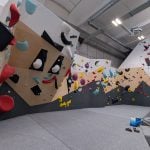
I walked into the Movement Boulder climbing facility, in awe of the size of it. The auditorium-style seating for hosting competitions and the impressive wall heights far exceeded my expectations for a climbing gym.
The first fear to appear in my consciousness was whether I would be able to scale these tall walls. Going from 24 feet of lead climbing to the 40-foot-tall walls in the Movement gym would be a challenge for my bouldering-inclined physique. What if I get pumped and fall off?, I wondered. I had no clue about the routesetting either. What angle would they expect us to climb?
All these questions fed my bigger fear of uncertainty. What did I sign myself up for? I wasn’t one hundred percent sure what I would have to demonstrate during this course. Would there be rescues? Would I have to haul someone much bigger than myself with a two- or three-to-one system? I had done it in the past, but it wasn’t something I practiced recently.
As more folks piled in, I started comparing myself to them. I could not help but notice I was the only woman. Did I belong in this group of experienced wall owners who had much bigger facilities than my little Rock Court? I wasn’t sure. Cue the imposter syndrome.

You Are Not the Only One
It turns out I did belong, and I did become a CWI Provider. Years later I now certify the folks who wish to become Providers as well as instruct professional routesetting and climbing wall instructors. With each course, I often hear or sense the same feeling from those in the courses: “I am not sure I belong here.”
With the popularity of social media and the influence on our egos of perfected videos and images depicting others at their best has come a deepening sense of insecurity about whether we do belong, whether we are good enough. Not sure of the accuracy of that statement? Look at the work of Jonathan Haidt, the author of The Anxious Generation, in which he discusses the challenges many young people are facing now, having grown up a little overprotected and unprepared to manage the overexposure they may experience through social media platforms. Or listen to Beth Rodden’s book, A Light Through the Cracks, where she talks about continually feeling like she should be better or be doing better, especially when comparing herself to others. Or dive into some of Brené Brown’s work, like The Gift of Imperfection, which reminded me of the times I’ve felt like I needed to perfect the image others see of me to belong or feel entitled to be in the room with everyone else.

If you prefer podcasts, The Mel Robbins Podcast or We Can Do Hard Things with Glennon Doyle and Abby Wambach both present similar ideas on feeling a need to perfect the image and control the narrative, and just how impossible it is to do so. And most recently there’s Holly Chen’s The Impact Driver Podcast episode at CBJ with routesetter Ethan Paris, who explored the origins and characteristics of imposter syndrome, how it impacts routesetters today and manifests across the gender spectrum, and the role community can play in combatting the phenomenon.
If I have learned one thing through the efforts of these authors and my own imposter syndrome experiences, it’s that everyone at some point will feel like they don’t belong, that they may not be ready. The point of this article is not whether we will feel that way, but what we can do about it.

5 Tips for Tackling Imposter Syndrome
When it comes to battling imposter syndrome, one size doesn’t necessarily fit all, but here are five practices that have helped me over the years:
1. Prepare
Understand what the experience you have signed up for will entail. Let’s say it’s a job interview at a climbing gym and you are feeling like an imposter in the role you’re applying to fill. Prepare for the interview by working on your knowledge of climbing and giving attention to the skills you feel less confident about. Prepare your body and mind well beforehand to reduce the stress on the big day. Sleep properly, eat properly, and ensure you can arrive early for the interview.
2. Do your homework before the event
If you’re preparing for an interview, remember it’s a two-way street; your expectations matter too, so come with notes in hand. Ask questions like what the expected level of ability for this job is, if any. What are the responsibilities of the position? What are the shift schedules like? What is the dress code for folks working in the gym? What are the policies and rules in the facility? Watch folks who work in the facility to gain some understanding of things they do during a shift.
3. Believe in your right to be there
Very often we are skilled enough to land the job or get the certification, but a nagging feeling of being an imposter can still stand in the way. Whether or not there’s some truth behind it, remember you’re not the only one who has felt this way. Everyone experiences the feeling of not being prepared enough at some point in their life. That should not be what stops you from trying. Reframing your expectations for the experience and how you will show up for it can make all the difference in what you get out of it, even if it ends up being not everything you hoped for.
4. Ask yourself what you want to bring to the experience
We often think about what we want to get from an experience. Reframe this lens to what you want to bring. If you’re heading into a certification, you can still bring something to the experience for others. Perhaps you have a great sense of humor or expertise in a different area which could support others who may be nervous during the assessment. For example, if you are trying to become a certified instructor and you have experience with babysitting, you likely have conflict resolution skills, discipline, and experience managing personal agendas, which can all come into play as an instructor. This knowledge can inform the experience and possibly be used to help support others who may be feeling less confident in those areas.
5. Treat it all like a classroom
Showing up is everything, even if we do find ourselves in over our head sometimes. If you signed up for a routesetting certification and quickly realize the folks are far more skilled than you are, you can still learn from their expertise. You may not get the certification, but the exposure to the skills demonstrated by others and the knowledge shared by a good instructor can still make the experience worth attending. Ask yourself what your takeaways are. Ask other participants about their experience and background. Their responses can provide you with a better understanding of what it takes to be a great setter and what areas you need to work on most.
The only caveat to this statement is to do no harm, or more plainly, do not create a situation where the instructors can’t properly do their job. But a good instructor can usually find a role for you even if you are not ready for the skills assessments.
So, as an instructor myself, speaking from one “imposter” to another: breathe in confidence, exhale doubt and just do your best!