The Short Beta series on CBJ helps youth coaches support the core clientele of a competitive youth program: the climbers on the team and their parents. Originally published on Jason Chang’s The Short Beta website, the essays in this series cover myriad topics that are relevant to youth climbers and their families, from the non-physical side of climbing to the puberty plateau, redpoint/onsite comp formats, isolation and volunteering. We encourage you to read, print and share these resources with your team; all we ask is that you give proper credit when doing so.

Intro by Naomi Stevens
In this next edition of The Short Beta series, we’re covering everyone’s favorite topic: puberty…
All jokes aside, parents of young female athletes may find it challenging to support their daughters as they experience puberty and navigate the impact it has on their climbing. Sure, we all went through puberty, but since competitive climbing wasn’t as popular as standard school sports from the late 80s to the early 2000s, many parents didn’t personally experience going through it as a competitive climber.
Puberty is an awkward time for anybody, and learning how to use your body for sport can provide added struggles. For girls, this time comes with uniquely frustrating challenges that can lead to a higher sport dropout rate than that of boys. The way puberty is discussed and handled around young girls in sport can be what makes or breaks their athletic journey.
Amy Hoffman, mother of two youth climbing competitors herself, addresses this issue in the article below, listing tips and tricks for encouraging girls to keep climbing competitively. She discusses the importance of developing an awareness of puberty, having role models, and setting goals unrelated to strength or grades.
Amy originally wrote this article for parents, but it’s a valuable resource for instructors of young female athletes as well. As a coach, you can put some of these practices into place yourself, or feel free to print them out and share them with the parents of climbers on your team.
And remember, as Amy Hoffman says, “the puberty plateau won’t last forever!”

Pushing Past the Puberty Plateau: Keeping Girls in Competition Climbing
Authored by Amy Hoffman
[Editor’s Note: An earlier version of this article was first published on The Short Beta website in 2019.]
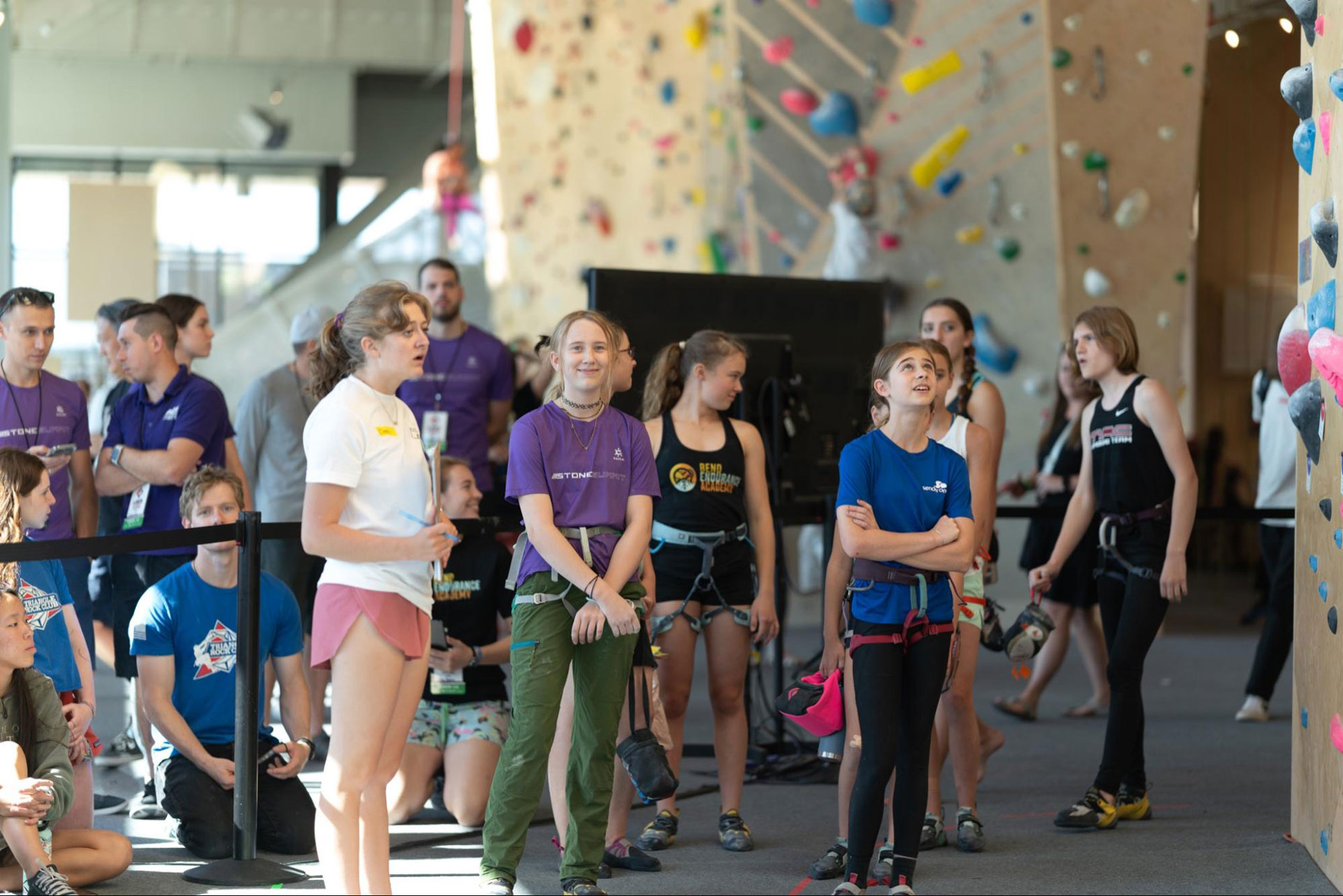
Hang around youth competition climbing long enough, a pattern will become visible: many, many girls and boys competing in the D and C categories; fewer in B, fewer still in A and Junior. This pattern happens for many reasons—high school sports take priority over an individual sport like climbing, school gets harder and requires more time, teenagers’ social lives become more important than the many hours spent in the climbing gym, and more. But for girls, frustration over their changing bodies can lead to dropping out of sports permanently. According to the Women’s Sports Foundation, “By age 14, many girls are dropping out of sports at two times the rate of boys.”
Common changes of puberty for girls include a small amount of weight gain, changes in body composition and center of gravity, skeletal growth before tendons catch up, and a smaller increase in strength than the boys get. A competitive girl climber may become discouraged when she can no longer climb as hard as the boys her age (at least for a time). This dynamic is not specific to climbing—studies suggest all sports that require balance and motor skills see a decrease in female participation as well as a temporary decrease or plateau in performance among girls. Once growth is finished, research indicates a female athlete’s body will stabilize and she will begin to see improvements in performance again, but that in-between time can be very frustrating.
So, how can you help your daughter stick with her sport through these changes? There are many layers to consider, including awareness, diet, training, injury prevention, etc. Our list is just scratching the surface, but hopefully these suggestions help you get started.
1. Increase awareness around puberty.
It begins with awareness. Sierra Blair-Coyle (2018 PanAm Bouldering Champion and pro climber), who grew up on the youth competition circuit, advises parents to increase awareness around puberty in a way that prepares your daughter for the changes to come: “At some point in your climbing career, you are going to hit puberty. For some people the changes happen rapidly and for other people they happen slowly. You could also notice changes earlier or later than your peers. Sometimes growing can make it more difficult to train and improve; you might not be progressing at your previous rate of improvement. While this can be annoying, it is unfortunately just another challenge you have to overcome in your climbing career. Everyone evens out eventually when they stop growing, and there is no substitute for hard work throughout this time. Even if you are feeling unmotivated or discouraged, keep charging forward!”

2. Make sure girls have female role models.
Climbing can be a bit male-dominated, so seeing women crushing is important. Whether these role models are female pro climbers who they follow on social media or coaches/climbing friends, help your daughter seek out women who have come through the puberty plateau stronger than ever and are still dedicated to their sport. Climbers like Kyra Condie, Meagan Martin, Brooke Raboutou, as well as an icon like Lynn Hill, all have Instagram accounts where they share their training, travel and competition experiences; Girls Who Climb organizes meet-ups for female climbers, both indoor and outdoor; and Rock Climbing Women and Brown Girls Climb are two more organizations that work to connect female climbers.
3. Expand the concept of goal setting.
Encourage your daughter to set goals that are not related to strength or climbing grades: She can work on footwork, coordination moves, endurance, or other climbing skills that will allow her to see improvement, even while she may not be seeing increases in the V grades.
4. Encourage a healthy relationship with food.
Make sure both that she is eating enough and that she is getting more healthful foods than junk. It’s important that girls put down enough bone density in their teenage years, and that they don’t try to prioritize body composition over health. Also, eating veggies, fruit, good protein and healthy carbs can help a female athlete maximize her time in the gym and keep her energy up all day. Watch for disordered eating, and reach out to your doctor if you think your daughter might need some help to keep healthy eating habits.
5. Celebrate sports and recreation, physical and mental well-being.
Support your daughter’s sports goals and help her to see the value of sports in her life as a whole: Climbing has a wonderful community and can provide life-long friendships and social opportunities. Fitness and strength are important, and time spent exercising is never wasted. Also, she will learn to persevere through difficulty, and the puberty plateau WON’T last forever—she will soon see gains again!
Special thanks to Sierra Blair-Coyle for sharing her advice.